Showing entries 381 to 390 of 5669
« 10 Newer Entries | 10 Older Entries »
Searching For: gp update (reset)
Scaling ProxySQL rapidly in Kubernetes

Editor’s Note: Because our bloggers have lots of useful tips, every now and then we update and bring forward a popular post from the past. Today’s post was originally published on November 26, 2019.

It’s not uncommon these days for us to use a high availability stack for MySQL consisting of Orchestrator, Consul and ProxySQL. You can read more details about this stack by reading Matthias Crauwels’ blog post How to Autoscale ProxySQL in the Cloud as well as Ivan Groenwold’s post on MySQL High Availability With ProxySQL, Consul and Orchestrator. The high-level concept is simply that Orchestrator will monitor the state of the MySQL replication topology and report changes to Consul which in turn can update ProxySQL hosts using …

[Read more]
MySQL Self-Join

I’m switching to MySQL and leveraging Alan Beaulieu’s Learning SQL as a supporting reference for my Database Design and Development course. While reviewing Alan’s Chapter 5: Querying Multiple Tables, I found his coverage of using self-joins minimal.

In fact, he adds a prequel_film_id column to the film table in the sakila database and then a single row to demonstrate a minimal self-join query. I wanted to show them how to view a series of rows interconnected by a self-join, like the following:

SELECT   f.title AS film
,        fp.title AS prequel
FROM     film f LEFT JOIN film fp
ON       f.prequel_id = fp.film_id
WHERE    f.series_name = 'Harry Potter'
AND      fp.series_name = 'Harry Potter'
ORDER BY f.series_number;

It returns the following result set:

[Read more]
Using Terraform to configure MySQL Database Service

Recently the MySQL Database Service (MDS) was launched in Oracle Cloud Infrastructure (OCI). As Cloud is about automation you don't have to use the Web Console to configure your instances, but can do it via API, for instance with the oci command line tool or your favorite programming language. However often it is nice to define the world in a declarative way ("I want a network, like this, and a MySQL database like that") and let the tool figure out how to align the reality in the cloud with your wish. A tool doing this is Terraform.

With Terraform you can declare the state in description files, the tool creates a dependency graph and then applies what has to be applied and of course it supports OCI and as part of the default OCI Provider, there is even directly …

[Read more]
Monitoring Percona Server for MySQL - Key Metrics

In this blog post, we are going to look into some key metrics and status when monitoring a Percona Server for MySQL to help us fine-tune the MySQL server configuration for a long run. Just for the heads up, Percona Server has some monitoring metrics that are only available on this build. When comparing on version 8.0.20, the following 51 statuses are only available on Percona Server for MySQL, which are not available in the upstream Oracle's MySQL Community Server:

  • Binlog_snapshot_file
  • Binlog_snapshot_position
  • Binlog_snapshot_gtid_executed
  • Com_create_compression_dictionary
  • Com_drop_compression_dictionary
[Read more]
Configure a MySQL Database Service (MDS) DB System

It’s now more than two months since MDS, the managed MySQL Server solution by Oracle MySQL team, hosted on Oracle Cloud Infrastructure (OCI), became available in several regions on the 1st of September. You can find online several resources online, such as:

If you haven’t tried it for free, time to do so with the …

[Read more]
Ansible Inventory Automation Using Consul and Orchestrator

Here at Pythian we get a lot of exposure to new technologies and implementation strategies via the work we do internally and for our clients. The most noteworthy technology stack that I’ve seen get a lot of traction in the MySQL community recently is the high availability stack including Orchestrator, Consul and ProxySQL. 

I won’t dive too deeply into the details of this implementation as there are several blog posts that our team has submitted on this topic, but the key thing I want you to keep in mind for this particular topic is the usage of Consul as a “source of truth” for the state of your MySQL replication clusters. If Orchestrator or its adjacent scripts are running as expected, Consul should always have the latest information pertaining to the state of your cluster. This is incredibly valuable. In fact, …

[Read more]
MySQL Cluster Backup and Restore

MySQL Ndb Cluster provides durability for data by default via logging and checkpointing.

In addition, users can take backups at any time, which allows for disaster recovery, replication synchronisation, data portability and other use cases.

This post looks at the backup and restore mechanisms in MySQL Ndb Cluster.

MySQL Ndb Cluster architecture recap

MySQL Ndb Cluster is a distributed SQL relational database :

  • Designed for low overhead read + write scale out, high availability, high throughput and low latency.
  • Providing distributed parallel joins, transactions, row locks, foreign keys.
  • Data is primarily stored and managed by a set of independent data node processes.
  • Data is accessed via distributed MySQL servers and …
[Read more]
Where's the MySQL Team from November to December 2020

We would like to return to the regular announcements about where you can find MySQL Community team or MySQL experts at during Nov-Dec 2020. All the shows we are attending by end of this year are mostly VIRTUAL ones. Please find more details below:

  • November, 2020:

    • GSCC2020/Virtual, November 14, 2020, @5:00-6:00pm

      • David Stokes, the MySQL Community Manager will be talking about "MySQL 8.0 Features for Developers"
    • MoodleMoot Global/Virtual, Nov 16-18, 2020
      • Please visit our online booth where you can talk online to our booth staff. Please also …
[Read more]
Configuring MySQL in a Docker Container

Editor’s Note: Because our bloggers have lots of useful tips, every now and then we update and bring forward a popular post from the past. Today’s post was originally published on May 23, 2018.

In recent weeks I’ve been focusing on Docker in order to get a much better understanding of the containerized world that is materializing in front of us. Containers aren’t just for stateless applications anymore and we’re seeing more cases where MySQL and other databases are being launched in a containerized fashion, so it’s important to know how to configure your MySQL container!

In docker hub, you will see an option for this by doing a volume mount from the Docker host to the container on /etc/mysql/conf.d. But the problem is that the container image you’re using may …

[Read more]
Conditional Updates

While I’m switching labs next term after more than a decade with more comprehensive lab set, I’m hoping the new exercises build the students’ core SQL skill set. Next term, I hope to see whether the change is successful. I’ve opted for using Alan Beaulieu’s Learning SQL: Generate, Manipulate, and Retrieve Data, 3rd Edition, because it’s a great book and uses the MySQL database.

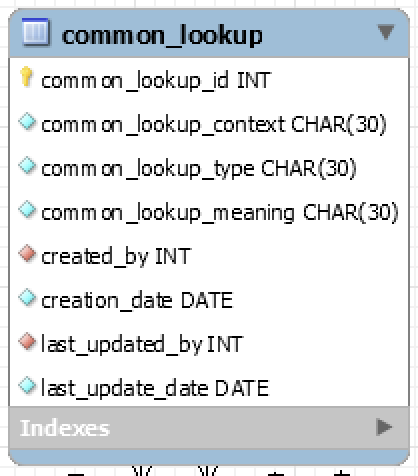
One exercise that the students will lose is a data migration exercise from a badly designed common_lookup table to a well designed common_lookup table. The starting point is shown below on the left and the fixed version is on the right.

         …

[Read more]
Showing entries 381 to 390 of 5669
« 10 Newer Entries | 10 Older Entries »