Sometimes clients want that the information they collected from the user should be encrypted and stored in a database. Data encryption and…
Continue reading on Thinkdiff »
[Read more]Sometimes clients want that the information they collected from the user should be encrypted and stored in a database. Data encryption and…
Continue reading on Thinkdiff »
[Read more]
There was an excellent question from Francis on my MySQL X DevAPI tutorial on how to work with
NULL values:
Is it possible to store an attribute with the null value, and how to find it (xxx is null ?
It may sound like a trivial question, but the answer is not all
that simple, so instead of just replying directly to the comment,
I think it is worth covering the subject of NULL
values in the X DevAPI in a separate post.
The Short Story
In short there are two ways to work with “not a value” in the X
DevAPI. One way is to not set a value for those fields in which
case you can compare the retrieved values with IS
NULL as you would for a relational table, for example in
MySQL Connector/Python:
# Find documents where "Birthday IS NULL" stmt_find = …[Read more]
These days, I mostly program in PHP with MySQL as the database,
which is just fine by me. I have had a long-time interest in
MySQL (SQL in general), and after several steady months
of programming in PHP, I must say I have really come into the
language and developed a fondness for it. All that being said, I
still enjoy using and learning the MySQL Shell in Python mode. As
Database Developers, we often need the LAST INSERT
ID value from a previous INSERT statement on
a column that has the AUTO_INCREMENT attribute.
MySQL Shell has a get_auto_increment_value() method
we can call against a Shell object result and retrieve that
value. Continue reading and see examples of the MySQL Shell
get_auto_increment_value() method used in Python
mode…
…
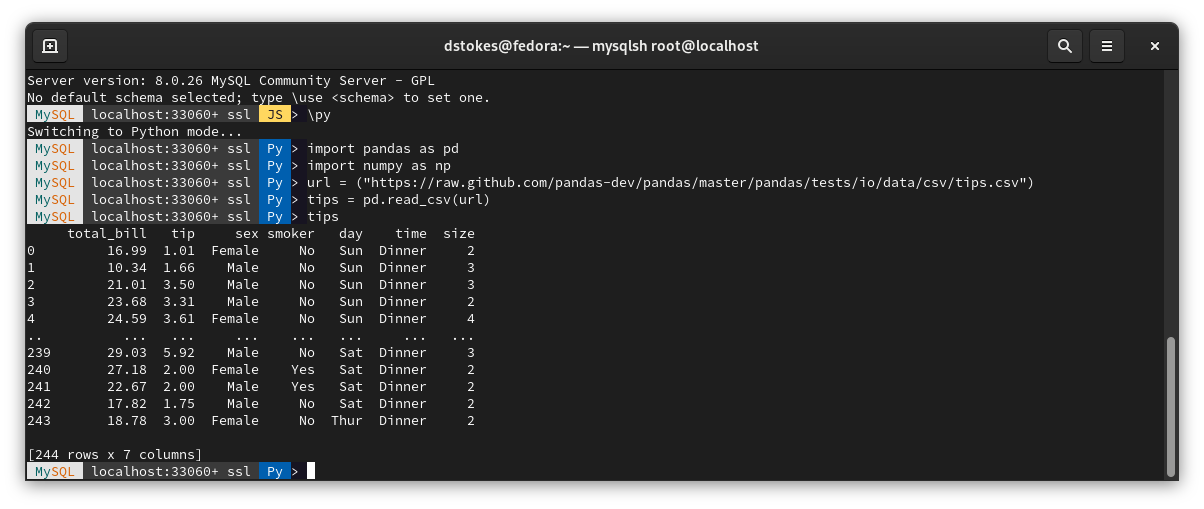
[Read more]I recently watched a fantastic Python Pandas library tutorial series on YouTube. Without a doubt, Pandas is great for all sorts of data stuff. On the same token, MySQL Shell in Python mode is quite powerful in the sense that Python and the MySQL Shell (version >= 8.0) are somewhat united in the same environment. Although Pandas is in a league all its own when it comes to data analysis, between the power of MySQL and Python, we can also perform some basic analysis easily in MySQL Shell Python mode. In this blog post, I will cover some basic data analysis using Python mode in the MySQL Shell. Continue reading to see examples…
Business vector created by freepik – www.freepik.com
OS, Software, and DB used:
Over the last few months, I have written numerous blog posts on different features of the MySQL Shell ranging from basic CRUD to aggregate functions and DDL. As a part of the MySQL version 8 release, MySQL Shell is a powerful and alternative environment that you can manage and work with your data in using a choice of 3 languages: Python, Javascript, or SQL. So this blog post is a simple compilation of all the Python mode related posts, in one easy-to-access location…
Photo by Tamara Gore on Unsplash
Self-Promotion:
If you enjoy the content written here, by all means, share this blog and your favorite post(s) with others who may benefit …
[Read more]
We all know as SQL professionals that a common use of the
ALTER TABLE command is that we can change a tables’
structure in a myriad number of ways. And, that’s a good thing
too because chances are, you won’t always nail down the
initial structure. Due to changing business or application
requirements, you may even have to add additional columns that
were not considered during the schema design phase. Suppose you
have many tables that are structured similarly and they all need
a specific column added to their already-existing design. Under
certain circumstances, using the MySQL Shell in Python mode
(\py), can reduce the number of manual
ALTER TABLE statements you have to type. Continue
reading to see examples in the MySQL Shell…
Photo by elCarito …
[Read more]Dear MySQL users,
MySQL Connector/Python 8.0.21 is the latest GA release version of
the
MySQL Connector Python 8.0 series. The X DevAPI enables
application
developers to write code that combines the strengths of the
relational
and document models using a modern, NoSQL-like syntax that does
not
assume previous experience writing traditional SQL.
To learn more about how to write applications using the X DevAPI, see
http://dev.mysql.com/doc/x-devapi-userguide/en/
For more information about how the X DevAPI is implemented in
MySQL
Connector/Python, and its usage, see
http://dev.mysql.com/doc/dev/connector-python
Please note that the X DevAPI requires at least MySQL Server
version 8.0
or higher with the …
Have you ever had to type out a massive CREATE TABLE
statement by hand? One with dozens of columns? Maybe several
dozens of columns? There are likely some GUI tools to help with
large CREATE TABLE commands. Or, other
drag-n-drop types of software that I am not familiar
with. What if you could write a few lines of Python code and take
care of a huge CREATE TABLE statement with way less
effort than typed manually? Interested? Continue reading
and see how using pandas, pyodbc, and MySQL…
Photo by Vorsen Furniture on Unsplash
OS, Software, and DB used:
Last Tuesday, it was the very first session of DB AMA, Morgan Tocker made a nice presentation of MySQL Performance_Schema and illustrated it with some nice queries to get Meta et Data Locks.
As those queries were not that simple to write or at least to remember, I thought it might be a good idea to add them to MySQL Shell, the best MySQL DBA Tool !
I’ve then added a new method to the check plugin:
getLocks().
Let’t see it in action:
As you can see, this is a small extension that can offers you a better view of what’s locked per transaction.
You can find several MySQL Shell Extension directly on github: …
[Read more]
Dear MySQL users,
MySQL Connector/Python 8.0.19 is the latest GA release version of
the
MySQL Connector Python 8.0 series. The X DevAPI enables
application
developers to write code that combines the strengths of the
relational
and document models using a modern, NoSQL-like syntax that does
not
assume previous experience writing traditional SQL.
To learn more about how to write applications using the X DevAPI,
see
http://dev.mysql.com/doc/x-devapi-userguide/en/
For more information about how the X DevAPI is implemented in
MySQL
Connector/Python, and its usage, see
http://dev.mysql.com/doc/dev/connector-python
Please note that the X DevAPI requires at least MySQL Server …