Showing entries 161 to 170 of 381
« 10 Newer Entries | 10 Older Entries »
Displaying posts with tag: Python (reset)
Snippet: Show column information using MySQL Connector/Python

Problem

You have a query executed by MySQL Connector/Python and would like to show column information nicely on the console.

Solution

Every cursor object has a description property. This can be used to show information about the columns in a result set.

columns = []
maxnamesize = 0
for coldesc in cur.description:
    coldesc = list(coldesc)
    coldesc[2:6] = []
    columns.append(coldesc)
    namesize = len(coldesc[0])
    if namesize > maxnamesize:
        maxnamesize = namesize

fmt = "{{nr:3}} {{name:{0}}} {{type:12}} {{null}}".format(
    maxnamesize+1)
colnr = 1
for column in columns:
    (colname, fieldtype, nullok, colflags) = column
    print(fmt.format(
        nr=colnr,
        name=colname,
        null='NOT …
[Read more]
Data Analytics at NBCUniversal. Interview with Matthew Eric Bassett.

“The most valuable thing I’ve learned in this role is that judicious use of a little bit of knowledge can go a long way. I’ve seen colleagues and other companies get caught up in the “Big Data” craze by spend hundreds of thousands of pounds sterling on a Hadoop cluster that sees a few megabytes [...]

MySQL Fabric support in Connector/Python

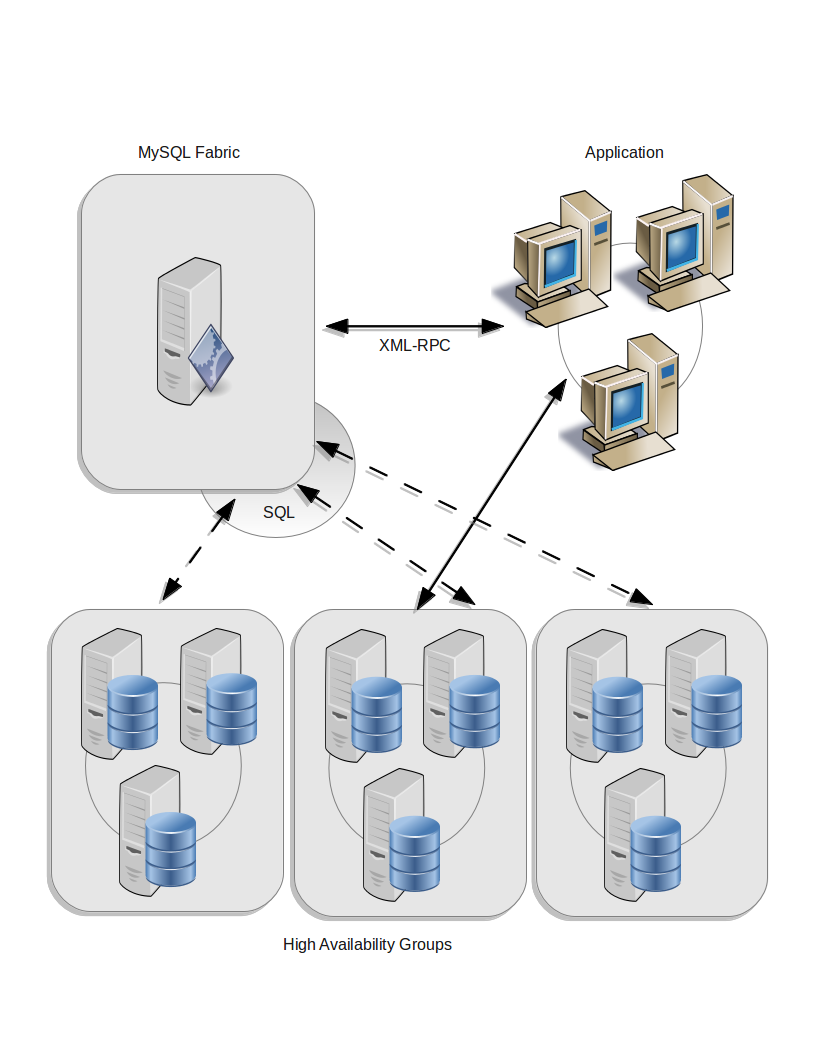
MySQL Fabric was officially introduced during Tomas his keynote at MySQL Connect 2013. MySQL Fabric will help you managing lots of MySQL server supporting both high-availability and sharding. Just like Connector/J, MySQL Connector/Python v1.1.1 Alpha has support for MySQL Fabric on MySQL Labs. Note that the MySQL Fabric as well as support for it in Connector/Python is Alpha.

When you download MySQL Connector/Python from MySQL Labs, you will also see a ZIP archive containing the MySQL Utilities documentation …

[Read more]
Tips to Build a Fault-tolerant Database Application

Applications should be written taking into account that errors will eventually happen and, in particular, database application developers usually consider this while writing their applications.

Although the concepts required to write such applications are commonly taught in database courses and to some extent are widely spread, building a reliable and fault-tolerant database application is still not an easy task and hides some pitfalls that we intend to highlight in this post with a set of suggestions or tips.

In what follows, we consider that the execution flow in a database application is characterized by two distinct phases: connection and business logic. In the connection phase, the application connects to a database, sets up the environment and passes the control to the business logic phases. In this phase, it gets inputs from a source, which may be an operator, another application or a component within the same …

[Read more]
Writing a Fault-tolerant Database Application using MySQL Fabric

In this post, we are going to show how to develop fault-tolerant applications using MySQL Fabric, or simply Fabric, which is an approach to building high availability sharding solutions for MySQL and that has recently become available for download as a labs release (http://labs.mysql.com/). We are going to focus on Fabric's high availability aspects but to find out more on sharding readers may check out the following blog post:

Servers managed by Fabric are registered in a MySQL Server instance, called backing store, and are …

[Read more]
MySQL Connector/Python v1.1.1 alpha: With Pooling and Django!

Connector/Python v1.1.1 is available for testing. It’s the second of a series of alpha releases which will bring some new features. Check out the Change History if you want to keep up with what is being added and changed.

Notable changes for v1.1.1:

Connector/Python v1.1.1 is alpha and although in good shape, it’s advised not to use it in production just yet.

Some …

[Read more]
MySQL Connector/Python v1.0.12 released

A few weeks ago we released MySQL Connector/Python v1.0.12. Bugs were fixed, and LOAD DATA LOCAL INFILE should now work correctly. The announcement can be read on the MySQL forums.

Some useful links:

[Read more]
ConFoo: The conference for web developers is looking for speakers.

ConFoo is currently looking for web professionals with deep understanding of PHP, Java, Ruby, Python, DotNet, HTML5, Databases, Cloud Computing, Security and Mobile development to share their skills and experience at the next ConFoo. Submit your proposals between August 26th and September 22nd.

ConFoo is a conference for developers that has built a reputation as a prime destination for exploring new technologies, diving deeper into familiar topics, and experiencing the best of community and culture.

  • ConFoo 2014 will be hosted on February 26-28 in Montreal, at the Hilton Bonaventure Hotel.
  • We take good care of our speakers by covering most expenses including travel, accommodation, lunch, full conference ticket, etc.
  • Presentations are 35min + 10min for questions, …
[Read more]
Announcing MySQL Utilities release-1.3.4 GA

The MySQL Utilities Team is pleased to announce the latest GA release of
MySQL Utilities. This release marks a milestone of concentrated effort to
expand the use of utilities in more diverse installations through improved
robustness, error handling, and quality.

Many Improvements
There are number such enhancements in this release. In this post we will
highlight a few of the more significant improvements.

  • (new utility) MySQL .frm Reader (mysqlfrm) - read .frm files and generate CREATE statements with or without a server connection.
  • (revised) improved documentation including a section on example administrative tasks - see http://dev.mysql.com/doc/workbench/en/mysql-utilities.html
  • MySQL Utilities is packaged for .msi, .rpl, .deb platforms and source .tar/.zip
[Read more]
MySQL variables module for ansible

I’ve create and another module for this besides the mysql_replication, named mysql_variables.

The purpose of this module to get/set variables from running MySQL servers, and avoid to use shell module for this, because that is a bit frustrating, and there are long commands to run.

For example, when you wanna to set read_only mode via shell, you can do that like this:

ansible db-secondary.bfc.kinja-ops.com -m shell -a "mysql -e 'select @@read_only'"
db-secondary.bfc.kinja-ops.com | success | rc=0 >>

[root@admin banyek]# ansible db-secondary.bfc.kinja-ops.com -m shell -a "mysql -e 'set global read_only=1'"
db-secondary.bfc.kinja-ops.com | success | rc=0 >>

Not so neat, isn’t it, eh? And I have not speak about the —user and —password variables, to this could be real annoying.

That’s why I made this module, because it is a bit easier to use (and I like to use own toolset with the …

[Read more]
Showing entries 161 to 170 of 381
« 10 Newer Entries | 10 Older Entries »