Does having small data-sets really help? Of course it does! Are memory lookups faster that disk lookups. Of course ! So many times I have seen people complain about queries taking too long now, while they were not taking that long earlier. There is one big reason for this, earlier the size of data-set was small so it could fit into memory. Now that the data-set has grown large enough that it cannot fit entirely into memory, the disk seeks really have slowed down the queries significantly. What to do now? Vertical partitioning. Divide the data-set into separate data-sets vertically....
Community journal
Follow the feed
The latest from the MySQL community
Ideas, releases, practical guides, and perspectives from the people building with MySQL.
Showing entries 71 to 80 of 122
« Previous |
Next »
Jun
13
2010
May
25
2010
InnoDB has an oft-unused parameter innodb_concurrency_tickets that seems widely misunderstood. From the docs: "The number of threads that can enter InnoDB concurrently is determined by the innodb_thread_concurrency variable. A thread is placed in a queue when it tries to enter InnoDB if the number of threads has already reached the concurrency limit. When a thread is allowed to enter InnoDB, it is given a number of “free tickets” equal to the value of innodb_concurrency_tickets, and the thread can enter and leave InnoDB freely until it has used up its tickets. After that point, the thread again becomes subject to the concurrency check (and possible queuing) the next time it tries to enter InnoDB. The default value is 500..."
What this means from a practical perspective is that each query is allocated 500 tickets when it begins executing. Each time it enters InnoDB, this number is decremented until it reaches zero ("entering InnoDB" …
[Read more]
The new ndbinfo interface in 7.1 is really useful to assist in
tuning MySQL Cluster. Here is an example (more will
follow):
I started with one test where I inserted two blobs (1KB + 1KB) in
one table.
From 16 threads (colocated with one mysqld, two data nodes,
separate computers) and one application driving the load I
reached about 6960TPS, and the utilization of the redo buffers
(controlled by the parameter RedoBuffer in
config.ini) looked like:
mysql< select * from ndbinfo.logbuffers;[Read more]
+---------+----------+--------+----------+----------+--------+
| node_id | log_type | log_id | log_part | total | used |
+---------+----------+--------+----------+----------+--------+
| 3 | REDO | 0 | 1 | 50331648 | 196608 |
| 3 | REDO | 0 | 2 | 50331648 | 294912 |
| 3 | REDO | 0 | 3 | 50331648 | 131072 |
| …
In vBulletin Board System there is session table contains online user information and tracking, in which forum now, what the current URL now, So it is have huge concurrent update statement, By default this table is MEMORY engine because its data not important in case MySQL restart.
I notice early loaded in MySQL and server, So I do full tuning for the server then analyze slow query using
Mar
09
2010
My proposal has been accepted, yay!
I'll be speaking on a topic that I feel passionate about:
MySQL Server Diagnostics Beyond Monitoring.
MySQL has limitations when it comes to monitoring and diagnosing
as it has been widely documented in several blogs.
My goal is to share my experience from the last few years and,
hopefully, learn from what others have done. If you have a
pressing issue, feel free to comment on this blog and I'll do my
best to include the case in my talk and/or post a reply if the
time allows.
I will also be discussing my future plans on sarsql. I've
been silent about this utility mostly because I've been
implementing it actively at work. I'll post a road map shortly
based on my latest experience.
I'm excited about meeting many old friends (and most now fellow
MySQL alumni) …
Mar
01
2010
Baron makes an excellent point in Why you should ignore MySQL’s key cache hit ratio — ratio is not the same as rate. Furthermore, rate is [often] the important thing to look at.
This is something that, at Pythian, we internalized a long time ago when thinking about MySQL tuning. In fact, mysqltuner 2.0 takes this into account, and the default configuration includes looking at both ratios and rates.
If I told you that your database had a ratio of temporary tables written to disk of 20%, you might think “aha, my database is slow because of a lot of file I/O caused by writing temporary tables to disk!”. However, that 20% ratio may actually mean a rate of 2 per hour — which is most likely …
[Read more]
Feb
23
2010
I've table contains text column and its charset is latin1, and i can store Arabic text ( and non English character) in this column and retrieve it, i don't know how is it?
So how is that? and why I need utf8?
CREATE TABLE `post` ( `postid` int(10) unsigned NOT NULL AUTO_INCREMENT, `threadid` int(10) unsigned NOT NULL DEFAULT '0', `parentid` int(10) unsigned NOT NULL DEFAULT '0', `
MySQL Cluster Performance Tuning Best Practices
Are you experiencing current performance bottlenecks in your high availability applications ? Are you designing a new mission-critical application and want to know how best to structure your schema and index strategy for optimal performance? Interested in how to transform your SQL into faster, more efficient queries?
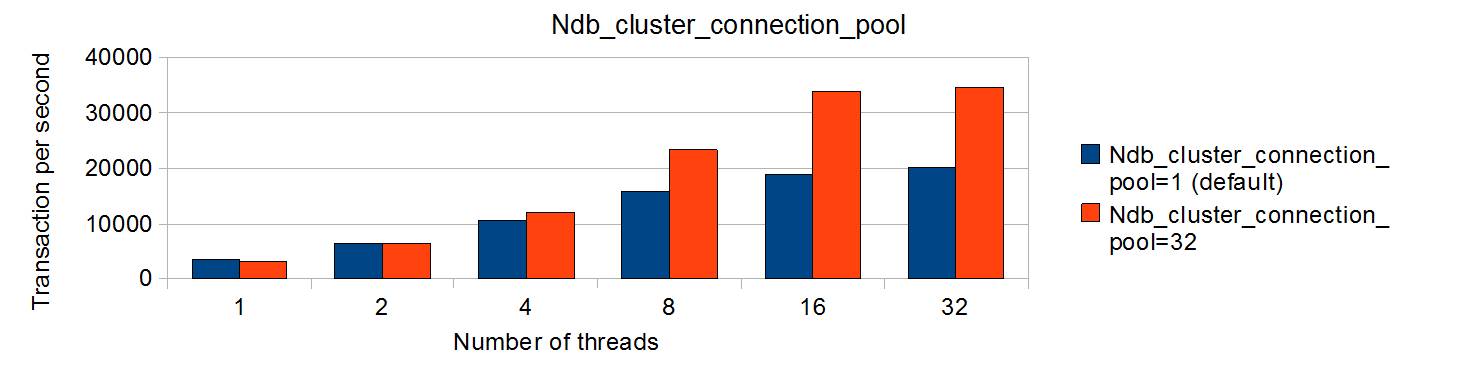
Benefits of connection pooling
Then this free web presentation is for you! You will get expert insight and learn best practices to help you identify those areas of database and application design that will give you the greatest benefits for performance when using MySQL Cluster.
We will discuss guidelines and best practices covering the following areas:
- General Design Concepts and Guidelines
- Schema …
Jan
14
2010
Since Ubuntu 8.04 aka Hardy Heron, I've had issues
with every new release. As Ubuntu evolves into being a viable
desktop OS alternative, its complexity has been growing and with
the new and improved looks new challenges arise. This bug in
particular has been very difficult to diagnose and I can't
imagine anyone without enough Linux experience to overcome it on
their own, so I decided to summarize the steps I took to fix it
... and vent my frustration at the end.
The SymptomI came across the issue for the first time while
trying Ubuntu's Karmic Netbook remix. After overcoming the
typical Broadcom wifi driver, Network Manager would
connect, but Firefox would fail to load the web pages 90%
of the time. Using ping in the command line worked just
fine. Maybe I needed to update the software packages to get the
latest patches, surprise, apt-get was having similar
problems and timing out. So the problem …
The latest version of Kontrollbase – the opensource enterprise MySQL analytics and performance tuning application – is available for download. Since the previous one, version 225, there have been a lot of great changes. The most significant being the development and inclusion of the Reporter CLI script – which is a combination of the client, [...]