Due to the growing popularity of Connector/Arduino, the moderator
of MySQL Forums has created a forum for us to meet up and discuss
the connector. Yippie!
http://forums.mysql.com/list.php?175
While the forum has been started very recently, I expect it will
grow quickly as people discover the connector for the first time
and experienced users find new and interesting ways to use it. I
hope to moderate the new forum periodically to answer questions
and respond to posts. See you there!
Note: you need an account to write to the forum. Click on
"register" in the upper right hand corner of the forum page to
create an account if you do not already have one.
Oct
23
2013
Oct
14
2013
MySQL is one of the most famous Open Source Relational Database Management System (RDBMS) created by Michael Widenius. Default choice in systems as WordPress and used by top companies as Google and Wikipedia. Due its simplicity and large community, it is largely used by developers and webmasters around the world. MySQL is under dual license: […]
Oct
10
2013
MySQL Connect Conference was a great success and I am really
happy for being
able to attend it this year. Oracle showed interesting
improvements and
exciting features in the upcoming MySQL 5.7 and released a very
early alpha
version of MySQL Fabric which is a framework for managing farms
of MySQL
servers.
You can find the presentations about MySQL Fabric on
SlideShare:
. MySQL Sharding: Tools and Best Practices for
Horizontal Scaling
. MySQL High Availability: Managing Farms of
Distributed Servers
If you haven't watched yet Edward Screven and Tomas Ulin keynote
on “The State
of the Dolphin”, please, click on the following …
Oct
08
2013
Going to MySQL Connect was truly a blast. We got a lot of good
questions and feedback in the sessions and there were a lot of
interest in both MySQL Fabric and the MySQL Applier for
Hadoop.
A big thank you to all that attended the talks, I got a lot of
good questions and comments that will help us build good
solutions.
The talks are available on SlideShare:
- MySQL Sharding: Tools and Best Practices for Horizontal Scaling
- MySQL Applier for Apache Hadoop: Real-Time Event Streaming to HDFS
- Sharding PHP with MySQL …
Oct
02
2013
Thanks to everyone who came. Definitely check out the recording
below!
Heyo everybody!
Coming up this Wednesday, October 2nd, 2013 at 12:00pm pacific (19:00 GMT) is another exciting #DBHangOps. Join the google hangout to discuss:
- MySQL Utilities from Chuck Bell!
- How do you constrain over-consumption of resources by competing applications?
- Network vs. Local storage for MySQL
- How do you use this for HA? Do you use DRBD or floating VIPs?
- Secure connections to MySQL (using SSL) (requested by Daniel)
- Do you have experience with this? What’s the performance impact?
- PCI Certification with MySQL — what changed for you?
- MySQL-isms!
- (From Gerry) Sub SELECTs — Why aren’t these as mature as other databases? …
Sep
21
2013
As you saw on the keynote, we are introducing an integrated
framework for managing farms of MySQL servers with support
for both high-availability and sharding. It should be noted that
this is a very early alpha and that it at this point is not ready
for production use.
MySQL Fabric is an integrated system for managing a collection of
MySQL servers and is the framework on which high-availability and
sharding is built. MySQL Fabric is open-source and is intended to
be extensible, easy to use, and support procedure execution even
in the presence of failure, an execution model we call
resilient execution.
To ensure high-availability, it is necessary to have redundancy
in the system. For database systems, the redundancy traditionally
takes the form of having a primary server acting as a master and
using replication to keep secondaries available to take over in
case the primary fails. This means that the "server" …
Sep
21
2013
Applications should be written taking into account that errors
will eventually happen and, in particular, database application
developers usually consider this while writing their
applications.
Although the concepts required to write such applications are
commonly taught in database courses and to some extent are widely
spread, building a reliable and fault-tolerant database
application is still not an easy task and hides some pitfalls
that we intend to highlight in this post with a set of
suggestions or tips.
In what follows, we consider that the execution flow in a
database application is characterized by two distinct phases:
connection and business logic. In the connection phase, the
application connects to a database, sets up the environment and
passes the control to the business logic phases. In this phase,
it gets inputs from a source, which may be an operator, another
application or a component within the same …
Sep
21
2013
In this post, we are going to show how to develop fault-tolerant
applications using MySQL Fabric, or simply Fabric, which
is an approach to building high availability sharding
solutions for MySQL and that has recently become available
for download as a labs release (http://labs.mysql.com/). We are going to focus
on Fabric's high availability aspects but to find out more on
sharding readers may check out the following blog post:
Servers managed by Fabric are registered in a MySQL Server instance, called backing store, and are …
[Read more]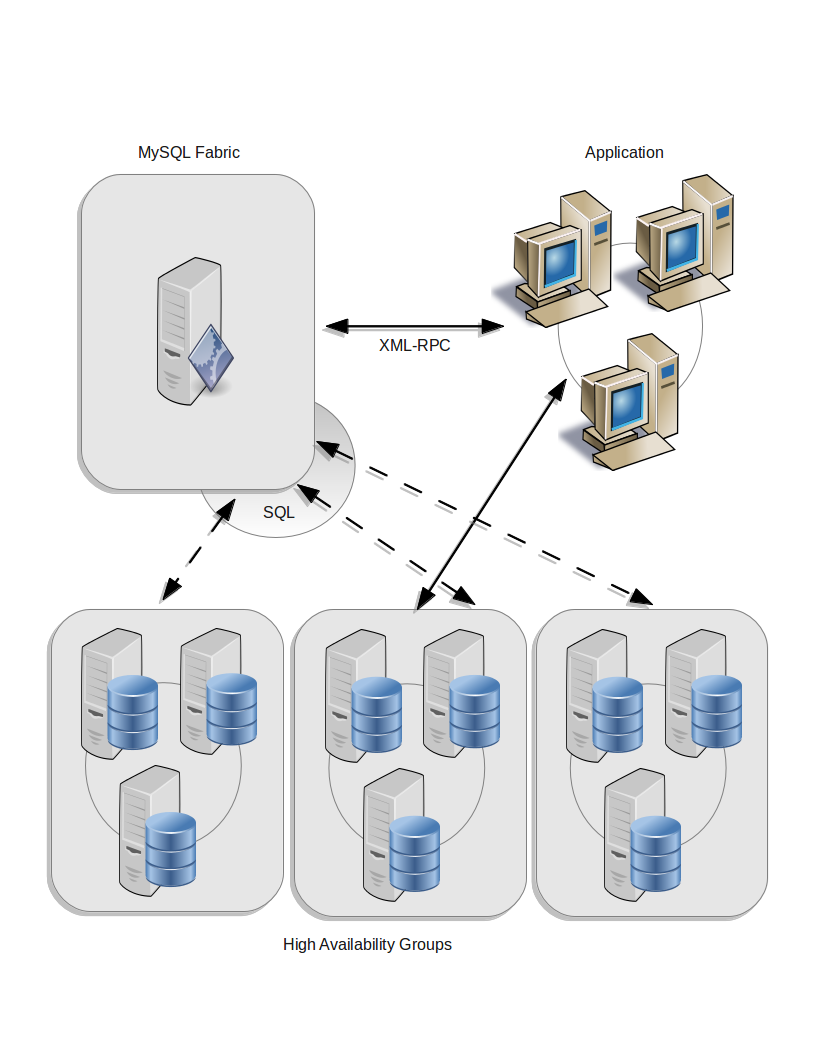
Sep
17
2013
And that’s a wrap! Check out the recording:
Hello!
Coming up this Wednesday, September 18th, 2013 at 12:00pm pacific (19:00 GMT) come and join #DBHangOps to discuss:
- Data warehousing in MySQL
- Shipping large tables from production to your Data warehouse
- Do you use Federated engine?
- What other solutions do you use?
- Answer some questions about MySQL-isms (requested by Tim
Callaghan)
- Why does MySQL have FRM files instead of storing them in a data dictionary table?
- Why doesn’t InnoDB support other page sizes?
- Why do we store data in a master.info file?
- What are you excited to see at MySQLConnect?
As always, take …
[Read more]
Sep
04
2013
Check out the video!
Hey there everybody!
Coming up this Wednesday, September 4th, 2013 at 12:00pm pacific (19:00 GMT) take part in #DBHangOps to discuss:
- Data Dictionary Corruption
- What is it?
- How does it happen?
- How did you fix it?
- What about FRM file corruption?
- MySQL Utilities (requested by Sheeri Cabral!)
- mysqlfrm — http://dev.mysql.com/doc/workbench/en/mysqlfrm.html
- Read about it at Chuck Bell’s blog http://drcharlesbell.blogspot.com/2013/04/mysql-utilities-new-frm-reader-utility.html …
- mysqlfrm — http://dev.mysql.com/doc/workbench/en/mysqlfrm.html