- Flare -- dynamically partitioning and reconstructing key-value server. Currently built on Tokyo Cabinet, but backend is theoretically pluggable. (via joshua on delicious)
- Implantable Device Offers Continuous Cancer Monitoring -- the sensor network begins to extend into our bodies. The cylindrical, 5-millimeter implant contains magnetic nanoparticles coated with antibodies specific to the target molecules. Target molecules enter the implant through a semipermeable membrane, bind to the particles and cause them to clump together. That clumping can be detected by MRI (magnetic resonance imaging). The device is made of a polymer called polyethylene, which is commonly used in orthopedic …
May
26
2009
May
26
2009
One of the better kept secrets about MySQL Cluster appears to be the flexibility available when setting up replication. Rather than being constrained to implementing a single replication scheme, you can mix and match approaches.
Just about every Cluster deployment will use synchronous replication between the data nodes within a node group to implement High Availability (HA) by making sure that at the point a transaction is committed, the new data is stored in at least 2 physical hosts. Given that MySQL Cluster is usually used to store the data in main memory rather than on disk, this is pretty much mandatory (note that the data changes are still written to disk but that’s done asynchronously to avoid slowing down the database).
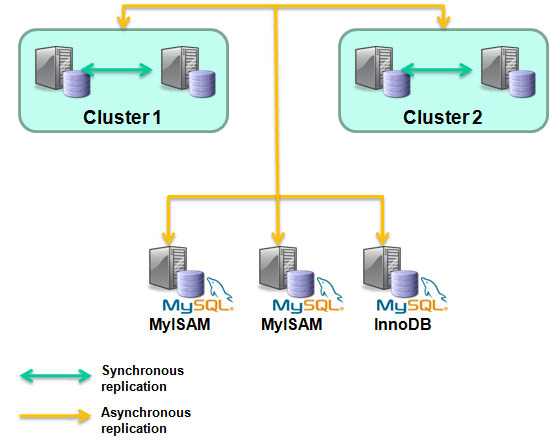
MySQL Cluster Replication
MySQL asynchronous replication is often used for …
[Read more]
May
26
2009
Following the launch of the Open Database Alliance a number of interesting reports were published that examined its role in establishing MariaDB as an alternative development branch for MySQL and as a vendor-neutral open source database collective.
I had a few questions myself, which Monty Widenius and Peter Zaitsev, CEO of Percona, were good enough to answer for me via email. They also agreed for the exchange to be published here. This is what they had to say:
Q: Monty has stated that the intention is to open up the Alliance to include other open source database projects - any indication of how this would be done given the diverse …
[Read more]
May
26
2009
Users of the ARCHIVE or NDB storage engines in MySQL may be aware of a MySQL feature known as “table discovery”. For ARCHIVE, you can copy the archive data file around between servers and it magically works (you don’t need to copy the FRM). For MySQL Cluster (NDB) it works so that when you CREATE TABLE on another MySQL server, other MySQL servers can get the FRM for these tables from the cluster.
With my work to replace the FRM with a protobuf structure in Drizzle and clean up parts of the API around it, this feature didn’t really survive in any working state.
Instead, I’m now doing things closer to the right way: pluggable metadata stores. The idea being that the whole “table proto on disk” (in MySQL it’s the FRM, but in Drizzle we’re now using a protobuf structure) code is pluggable and could be replaced by an implementation specific to an engine (e.g. the innodb or ndb data dictionaries) or a different …
[Read more]
May
26
2009
One of the cool things about talking about MySQL performance with ZFS is that there is not much tuning to be done Tuning with ZFS is considered evil, but a necessity at times. In this blog I will describe some of the tunings that you can apply to get better performance with ZFS as well as point out performance bugs which when fixed will nullify the need for some of these tunings.
For the impatient, here is the summary. See below for the reasoning behind these recommendations and some gotchas.
- Match ZFS recordsize with Innodb page size (16KB for Innodb Datafiles, and 128KB for Innodb log files).
- If you have a write heavy workload, use a Seperate ZFS Intent Log.
- If your database working set size does not fit in memory, …
May
26
2009
One of the cool things about talking about MySQL performance with ZFS is that there is not much tuning to be done Tuning with ZFS is considered evil, but a necessity at times. In this blog I will describe some of the tunings that you can apply to get better performance with ZFS as well as point out performance bugs which when fixed will nullify the need for some of these tunings.
For the impatient, here is the summary. See below for the reasoning behind these recommendations and some gotchas.
- Match ZFS recordsize with Innodb page size (16KB for Innodb Datafiles, and 128KB for Innodb log files).
- If you have a write heavy workload, use a Seperate ZFS Intent Log.
- If your database working set size does not fit in memory, …
May
26
2009
Solaris Cluster comes bundled with rich support for numerous
software applications.
Follow the link to see a list of all the Solaris Cluster
Agents available in the latest release of Solaris
Cluster - SC 3.2 01/09.
For most of these applications the latest versions are
supported. In this blog I specifically want to highlight
the latest support
for the SAP NetWeaver stack and highlight some key features
provided by Solaris Cluster to make SAP highly available on
Solaris.
Solaris Cluster 3.2 HA SAP Web Application Server agents now
support SAP 7.1 on S10 SPARC and X64. You will need
patch# 126062-06 or later for S10 SPARC or patch# 126063-07 or
later for S10 X64. This patch is required for the following
Resource Types (RTs) - SUNW.sapenq, SUNW.saprepl, SUNW.sapscs, …
May
26
2009
Solaris Cluster comes bundled with rich support for numerous
software applications.
Follow the link to see a list of all the Solaris Cluster
Agents available in the latest release of Solaris
Cluster - SC 3.2 01/09.
For most of these applications the latest versions are
supported. In this blog I specifically want to highlight
the latest support
for the SAP NetWeaver stack and highlight some key features
provided by Solaris Cluster to make SAP highly available on
Solaris.
Solaris Cluster 3.2 HA SAP Web Application Server agents now
support SAP 7.1 on S10 SPARC and X64. You will need
patch# 126062-06 or later for S10 SPARC or patch# 126063-07 or
later for S10 X64. This patch is required for the following
Resource Types (RTs) - SUNW.sapenq, SUNW.saprepl, SUNW.sapscs, …
May
26
2009
To all people, interested to see a presentation/live demo of
MySQL Workbench 5.1 and 5.2 - you’re welcome to join the MySQL
Workbench Web-Seminar, held tomorrow, May 27th at 15:00 CET.
Important side-note: it’s held in German!
For about 45 minutes I will walk you through various parts of the
application and show many features live from my screen:
- Overview of the interface
- How to create tables and other objects
- Layouting objects on the canvas
- Show how to get your model to the database (and back)
- Take a quick look into the scripting interface
- See the database querying of upcoming 5.2 in action
Every participant will be able to ask questions via chat during the presentation and subsequently there will be a Q&A for about 15 mins. The session is free to attend, all you need to do is head over to the Registration-page and enter your …
[Read more]
May
26
2009
So I spent the weekend looking at places where we may have missed something in the code for waffle. You can actually see some of the stuff I tried in the bug on launchpad about this, but the weird thing is the very last thing I tried. As I took a step back and looked at the problem ( secondary index corruption ) and our assumption that we “missed” something, I decided to find the place where pages are written to disk and to push to memcached from here as well as from the LRU. With the double write buffer enabled that place should be buf_flush_buffered_writes. By pushing to memcached here we should eliminate the page that falls through the cracks of the LRU. Basically this should help ensure memcached has an exact copy of the data that exists on disk. The result? It failed with the same secondary index failure. This means:
a.) maybe we have a problem in the …
[Read more]