Every company needs to see stats to understand how the
application is performing, and how users are using the
application(s). Typically a stat for most basic questions and
even some advance questions can be summarized as "What is
said event over time?". We call this EventTracker.
To add to the complexity of generating stats, how do you get stat
events from a DataCenter (DC) in Singapore, a DC in Western
Europe, a DC in Oregon to a database for querying in West
Virginia - near real-time? I used multisource replication, and
the BLACKHOLE storage-engine to do so with MariaDB.
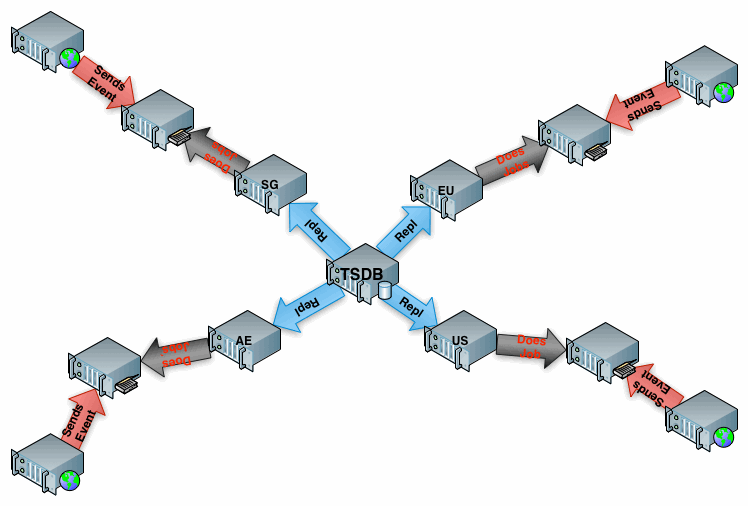
Above is an image that shows a Webserver in some part of the
world sends Events for tracking various interrupts to a
BeanstalkD queue at time T in the same region. Each Region has a
set of Python workers …
Hi,
You can find below the slides of the MySQL Connect 2013,
enjoy!
(and much more in the slides
page)
Once upon a time, it was a very common MySQL choice to have an application split its queries between two connections, sending reads to a slave and writes directly to the master.
I won’t say this technique is no longer used (it certainly is) but I have been observing its popularity decline slowly over the years. Today I wanted to try and provide insight into some of the possible reasons:
-
InnoDB as default. MyISAM table locks are very high impact for high throughput systems - worse still, MyISAM does not have MVCC, an algorithm that allows InnoDB reads to be non blocking. Running with multiple replication slaves was very important to distribute read-locks across an array of servers. With InnoDB, for most people this should now be a non-issue.
-
…
I want to thank all attendees of my webinar, “MySQL 5.6 New Replication Features: Benefits, Challenges and Limitations“. We had questions that I didn’t have the time to answer:

Q: If I run on Amazon’s RDS, do I need to worry about enabling crash-safe slaves, or is that already in place?
A: Crash-safe replication is already configured for read replicas using MySQL 5.6.
Q: How the relay log purge will manage in case of multiple db’s replication running on multiple threads?
A: Same thing as with single-threaded replication: when all event in a relay log file have been executed, …
[Read more]October 28, 2013 By Severalnines
Data protection is vital for DB admins, especially when it involves data that is accessed and updated 24 hours a day. Clustering and replication are techniques that provide protection against failures, but what if a user or DBA issues a detrimental command against one of the databases? A user might erroneously delete or update the contents of one or more tables, drop database objects that are still needed during an update to an application, or run a large batch update that fails midway. How do we recover lost data?
In a previous post, we showed you how to do a full restore from backup. Great, now you’ve restored up to the last incremental backup that was done at 6am this morning. But how about the rest of the data?
This is where you’d do a …
[Read more]
Percona Server version 5.5.34-32.0
Percona is glad to announce the release of Percona Server 5.5.34-32.0 on October 28th, 2013 (Downloads are available here and from the Percona Software Repositories). Based on MySQL 5.5.34, including all the bug fixes in it, Percona Server 5.5.34-32.0 is now the current stable release in the 5.5 series. All of Percona‘s software is open-source and free, all the details of the …
[Read more]Percona Server version 5.1.72-14.10
Percona is glad to announce the release of Percona Server 5.1.72-14.10 on October 28th, 2013 (Downloads are available here and from the Percona Software Repositories). Based on MySQL 5.1.72, including all the bug fixes in it, Percona Server 5.1.72-14.10 is now the current stable release in the 5.1 series. All of Percona‘s software …
[Read more]Want to develop and use applications with PHP and the MySQL database? Consider taking the MySQL and PHP: Developing Dynamic Web Applications training course.
Before taking this course you should:
- Understand how HTML files are assembled
- Understand fundamental PHP syntax
- Have some programming experience (preferably PHP)
- Have some experience with relational databases
- Have some knowledge of Object-Oriented Programming
This 4-day live, instructor-led course is perfect for developers
who use PHP and MySQL to build and maintain their websites and
who want to learn how PHP and MySQL can be used to rapidly
prototype and deploy dynamic websites.
You can take this course as a: …
[Read more]If you install a MySQL Database Server with the default options, your data are insecure and your server is in risk of invasion and some performance issues will appear shortly. With some best practices, your MySQL database becomes secure and the performance goes well. 1 – Set root password and change its login name As... Read More
The post MySQL Security Best Practices appeared first on Devops for Dummies.
The procedure for using the PAM authentication plugin as documented doesn't work flawlessly on
Ubuntu.
So here is how it works on Ubuntu (and probably also on other
Debian based systems).
Please note that the PAM authentication plugin is an enterprise
feature.
1. Make sure the plugin is loaded
This can be done by adding the following to the mysqld section of
my.cnf (Don't forget to restart). You could also use INSTALL
PLUGIN to load it without restart.
plugin-load=authentication_pam.so
2. Add a user which will use the plugin
mysql> CREATE USER 'dveeden'@'localhost' IDENTIFIED WITH authentication_pam;
Query OK, 0 rows affected (0.00 sec)
3. Add a pam config file for 'mysql':
Create /etc/pam.d/mysql with the following …