Showing entries 2501 to 2510 of 22617
« 10 Newer Entries | 10 Older Entries »
Displaying posts with tag: MySQL (reset)
Enabling Autorecovery for the Tungsten Replicator

The Replicator is a critical piece of the Tungsten Clustering solution for MySQL / MariaDB, as well as its own stand-alone data replication product. Automatic recovery is a feature that enables the Replicator to go back online in the event of a transient failure. In this blog we discuss how to enable Automatic Recovery. For more information about Auto-Recovery, please click here to visit the online documentation page.

The Question Recently, a customer asked us:

We see that the replicators receive a transaction which has a deadlock error in it:

pendingError : Event application failed: seqno=82880882 fragno=0 message=java.sql.SQLTransactionRollbackException: Deadlock found when trying to get lock; try restarting transaction

If one performs a service online, it comes back online without issue and continues …

[Read more]

MySQL 5.6/Maria 10.1 : How we got from 30k qps to 101k qps…..

Late one evening, I was staring at one of our large MySQL installations and noticed the database was hovering around 7-10 run queue length (48 cores, ~500 gigs memory, fusionIO cards). I had been scratching my head on how to get more throughput from the database. This blog records the changes I made to tune performance in order to achieve a 300% better throughput in MySQL. I tested my theories on MySQL 5.6/Maria 10.1. While with 5.7 DBAs would turn to performance_schema for the supporting metrics, I hope that you find the process interesting nevertheless.

View from an Oracle RDBMS DBA…

For context, I came to MySQL from a background as an Oracle RDBMS DBA, and this informs my expectations. For this exercise, unlike with Oracle RDBMS, I had no access to view wait events so that I could see where my database was struggling. At least, no access in MySQL 5.6/Maria 10.1 without taking a performance hit by using …

[Read more]
Why You Need to Know What You Don’t Know

Author: Robert Agar

In the complicated world of database management, a lot of data needs to be assimilated by those responsible for keeping the systems healthy and operational. Management and the database team can be challenged trying to stay on top of all the moving parts required to keep things running smoothly. This task can prove to be quite difficult when faced with a large number of databases which may encompass several diverse platforms.

There are many different database products from which to choose. Some are more appropriate for particular uses which may play a role in your decision to go with one solution over another. Open-source databases are very popular, and MySQL has a large lead in the number of users it supports. It is the top-ranked open-source database in terms of popularity. When …

[Read more]
Blog from the Top — What keeps you up at night? Sleep better with Continuent!

Database Administration is a tough, often ungrateful job. Especially if you run a 24/7 business-critical MySQL or MariaDB deployment.

MySQL has proven to be a remarkably solid database which supports billions of dollars in revenue. On some level this very solidity creates a false sense of security. There are many things that can wrong at any given time, whether that is a change to your app, a bug in the database, hardware failure or just simply running out of disk space.

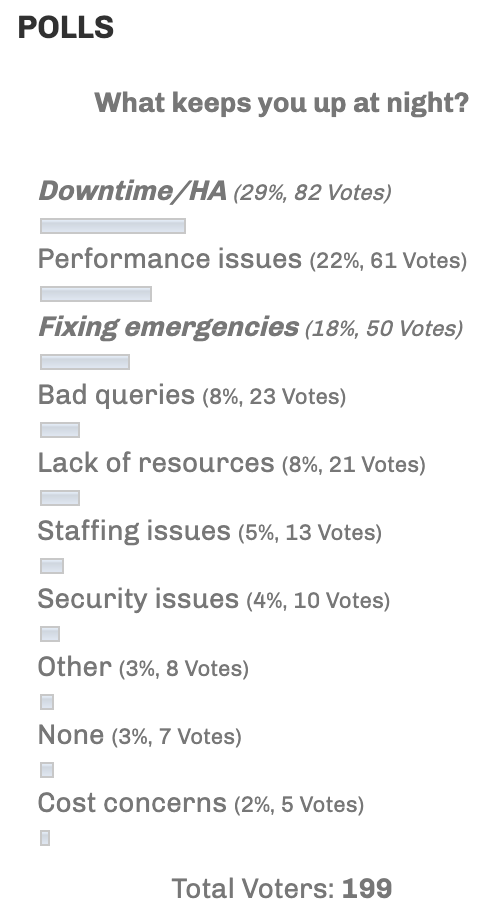
Percona recently conducted a poll: “What keeps you up at night?”

Not surprisingly, “Downtime/HA” is very high on the list.

While there are many challenging issues and tasks that a DBA must deal …

[Read more]
Webinar 8/7: Performance Analyses and Troubleshooting Technologies for Databases

Please join Percona CEO Peter Zaitsev as he presents “Performance Analyses and Troubleshooting Technologies for Databases” on Wednesday, August 7th, 2019 at 11:00 AM PDT (UTC-7).

Register Now

Have you heard about the USE Method (Utilization – Saturation – Errors), RED (Rate – Errors – Duration) or Golden Signals (Latency – Traffic – Errors – Saturations)?

In this presentation, we will talk briefly about these different-but-similar “focuses” and discuss how we can apply them to data infrastructure performance analysis troubleshooting and monitoring.

We will use MySQL as an example, but most of this talk applies to other database technologies as well.

[Read more]
RAID – Redundant Storage for Database Reliability

Database Reliability Engineering – How to decide RAID for your Database Infrastructure ? What is RAID?

RAID stands for Redundant Array of Independent Disks (Originally, the term RAID was defined as Redundant Array of Inexpensive Disks). The name indicates that the disk drives are independent, and are multiple in number. RAID storage uses multiple disks in order to provide fault tolerance, to improve overall performance, and to increase storage capacity in a system. This is in contrast with older storage devices that used only a single disk drive to store data.How the data is distributed between these drives depends on the RAID level used. The main advantage of RAID, is the fact that, to the operating system the array of disks can be presented as a single disk.RAID is fault tolerant because in most of the RAID level’s data is redundant in multiple disks, so …

[Read more]
MySQL fails to start and no errors in the log? Check out this possible reason!

Some time ago, I was building a new MySQL DB server (5.7.25) and like all DBAs, I have a template of my.cnf that I use for the new instances after changing a few variables based on the instance resources, replication … etc. I had MySQL installed but I struggled on having the service started!

MySQL failed to start, no errors were printed at all in the MySQL error log – or the log was not created from the first place – even no errors in the system log and I had no clue what was going on!

After some digging in, I found the bad guy! The variable secure_file_priv referred to a directory that didn’t exist. When I had the directory created, everything was fine and the service started.

I tried to repeat the same scenario in MySQL 8 and it was much better. The error log indicated the root cause of the issue as below:
2019-03-25T23:39:59.810992Z 0 [ERROR] [MY-010095] [Server] Failed …

[Read more]
MySQL 8.0.17 Clone Plugin: How to Create a Slave from Scratch

In this post, we will discuss a new feature – the MySQL 8.0.17 clone plugin. Here I will demonstrate how easy it is to use to create the “classic” replication, building the standby replica from scratch.

The clone plugin permits cloning data locally or from a remote MySQL server instance. The cloned data is a physical snapshot of data stored in InnoDB, and this means, for example, that the data can be used to create a standby replica.

Let’s go to the hands-on and see how it works.

Installation & validation process of the MySQL 8.0.17 clone plugin

Installation is very easy and it works in the same as installing other plugins. Below is the command line to install the clone plugin:

master …
[Read more]
How to Build a Percona Server “Stack” on a Raspberry Pi 3+

The blog post How to Compile Percona Server for MySQL 5.7 in Raspberry Pi 3 by Walter Garcia, inspired me to create an updated install of Percona Server for the Raspberry Pi 3+.

This how-to post covers installing from source and being able to use Percona Server for MySQL in any of your maker projects. I have included everything you need to have a complete Percona Server, ready to store data collection for your weather station, your GPS data, or any other project you can think of that would require data collection in a database.

My years of hands-on support of Percona Server enable me to customize the install a bit. I wanted to build a full Percona …

[Read more]
Tungsten Clustering 5.4.0 and Tungsten Replicator 5.4.0 Released

Continuent is pleased to announce that the following new software releases are now available:

  • Tungsten Clustering version 5.4.0
  • Tungsten Replicator version 5.4.0

Releases 5.4.0 is significant in that it introduces MySQL 8 support, along with many new features, stability improvements and bug fixes.

Highlights common to both products:

Improvements, new features and functionality

  • Two new utility scripts have been added to the release to help with setting the Replicator position:
    • tungsten_find_position, which assists with locating information in the THL based on the provided MySQL binary log event position and outputs a dsctl set
[Read more]
Showing entries 2501 to 2510 of 22617
« 10 Newer Entries | 10 Older Entries »