Showing entries 1641 to 1650 of 5669
« 10 Newer Entries | 10 Older Entries »
Searching For: gp update (reset)
Creating and Restoring Database Backups With mysqldump and MySQL Enterprise Backup – Part 2 of 2

In part one of this post, I gave you a couple examples of how to backup your MySQL databases using mysqldump. In part two, I will show you how to use the MySQL Enterprise Backup (MEB) to create a full and partial backup.


MySQL Enterprise Backup provides enterprise-grade backup and recovery for MySQL. It delivers hot, online, non-blocking backups on multiple platforms including Linux, Windows, Mac & Solaris. To learn more, you may download a …
[Read more]
Log Buffer #423: A Carnival of the Vanities for DBAs

This Log Buffer edition covers Oracle, SQL Server and MySQL blog posts from all over the blogosphere!


Oracle:

Hey DBAs:  You know you can  install and run Oracle Database 12c on different platforms, but if you install it on an Oracle Solaris 11 zone, you can take additional advantages.

Here is a video with Oracle VP of Global Hardware Systems Harish Venkat talking with Aaron De Los Reyes, Deputy Director at Cognizant about his company’s explosive growth & how they managed business functions, applications, and supporting infrastructure for success.

Oracle …

[Read more]
A quick update on our native Data Dictionary

In July 2014, I wrote that we were working on a new native InnoDB data dictionary to replace MySQL's legacy frm files.

This is quite possibly the largest internals change to MySQL in modern history, and will unlock a number of previous limitations, as well as simplify a number of failure states for both replication and crash recovery.

With MySQL 5.7 approaching release candidate (and large changes always coming with risk attached) we decided that the timing to try to merge in a new data dictionary was just too tight. The data dictionary development is still alive and well, but it will not ship as part of MySQL 5.7.

So please stay tuned for updates... and thank you for using MySQL!

Installing Kubernetes Cluster with 3 minions on CentOS 7 to manage pods and services

Kubernetes is a system for managing containerized applications in a clustered environment. It provides basic mechanisms for deployment, maintenance and scaling of applications on public, private or hybrid setups. It also comes with self-healing features where containers can be auto provisioned, restarted or even replicated. 

Kubernetes is still at an early stage, please expect design and API changes over the coming year. In this blog post, we’ll show you how to install a Kubernetes cluster with three minions on CentOS 7, with an example on how to manage pods and services. 


Kubernetes Components

Kubernetes works in server-client setup, where it has a master providing centralized control for a number of minions. We will be deploying a Kubernetes master with three minions, as illustrated in the diagram further below.

Kubernetes has several components:

[Read more]
Workload Analysis with MySQL's Performance Schema

Earlier this spring, we upgraded our database cluster to MySQL 5.6. Along with many other improvements, 5.6 added some exciting new features to the performance schema.

MySQL's performance schema is a set of tables that MySQL maintains to track internal performance metrics. These tables give us a window into what's going on in the database—for example, what queries are running, IO wait statistics, and historical performance data.

One of the tables added to the performance schema in 5.6 is table_io_waits_summary_by_index. It collects statistics per index, on how many rows are accessed via the storage engine handler …

[Read more]
Combining work with MySQL and MongoDB using Python

Recently i have reviewed a simple web application, where problem was with moving “read” count of news from main table to another table in MySQL. The logic is separating counting “read”s for news from base table. The way you can accomplish this task, you can create a new “read” table in MySQL, then add necessary code to news admin panel for inserting id,read,date into this new “read” table, while adding new articles. But for test purposes, i decide to move this functionality to MongoDB. Overall task is -> Same data must be in MySQL, counting logic must be in MongoDB and data must be synced from MongoDB to MySQL. Any programming language will be sufficient but, Python is an easy one to use. You can use Official mysql-connector-python and pymongo. Firstly you must create empty “read” table in MySQL, insert all necessary data from base table to “read” and there should be after insert trigger for …

[Read more]
Bash Arrays & MySQL

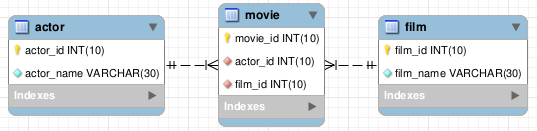
Student questions are always interesting! They get me to think and to write. The question this time is: “How do I write a Bash Shell script to process multiple MySQL script files?” This post builds the following model (courtesy of MySQL Workbench) by using a bash shell script and MySQL script files, but there’s a disclaimer on this post. It shows both insecure and secure approaches and you should avoid the insecure ones.

It seems a quick refresher on how to use arrays in bash shell may be helpful. While it’s essential in a Linux environment, it’s seems not everyone masters the bash shell.

Especially, since I checked my …

[Read more]
Building a better DatabaseCache for Django on MySQL

I recently released version 0.1.10 of my library django-mysql, for which the main new feature was a backend for Django’s cache framework called MySQLCache. This post covers some of the inspiration and improvements it has, as well as a basic benchmark against Django’s built-in DatabaseCache.

TL;DR - it’s better than DatabaseCache, and if you’re using MySQL, please try it out by following the instructions linked at the end.

Why bother?

Django’s cache framework provides a generic API for key-value storage, and gets used for a variety of caching tasks in applications. It ships with multiple backends for popular technologies, including Redis and Memcached, as well as a basic cross-RDBMS DatabaseCache. The DatabaseCache is recommended only for …

[Read more]
FromDual.en: FromDual Performance Monitor for MySQL and MariaDB 0.10.4 has been released

Taxonomy upgrade extras:  mysql performance monitor monitoring fpmmm maas performance monitor mpm

FromDual has the pleasure to announce the release of the new version 0.10.4 of its popular Database Performance Monitor for MySQL, MariaDB, Galera Cluster and Percona Server fpmmm.

You can download …

[Read more]
FromDual.en: FromDual Performance Monitor for MySQL and MariaDB 0.10.4 has been released

FromDual has the pleasure to announce the release of the new version 0.10.4 of its popular Database Performance Monitor for MySQL, MariaDB, Galera Cluster and Percona Server fpmmm.

You can download fpmmm from here.

In the inconceivable case that you find a bug in fpmmm please report it to our Bug-tracker.

Any feedback, statements and testimonials are welcome as well! Please send them to feedback@fromdual.com.

This release contains various minor bug fixes and improvements.

New installation of fpmmm v0.10.4

Please follow our mpm installation …

[Read more]
Showing entries 1641 to 1650 of 5669
« 10 Newer Entries | 10 Older Entries »