Showing entries 3451 to 3460 of 22619
« 10 Newer Entries | 10 Older Entries »
Displaying posts with tag: MySQL (reset)
What is the Top Cause of Application Downtime Today?

I frequently talk to our customer base about what keeps them up at night. While there is a large variance of answers, they tend to fall into one of two categories. The first is the conditioned fear of some monster lurking behind the scenes that could pounce at any time. The second, of course, is the actual monster of downtime on a critical system. Ask most tech folks and they will tell you outages seem to only happen late at night or early in the morning. And that they do keep them up.

Entire companies and product lines have been built around providing those in the IT world with some ability to sleep at night. Modern enterprises have spent millions to mitigate the risk and prevent their businesses from having a really bad day because of an outage. Cloud providers are attuned to the downtime dilemma and spend lots of time, money, and effort to build in redundancy and make “High Availability” (HA) as easy as possible. The frequency of …

[Read more]
Next week in Barcelona

Next week I will be speaking at DataOps in Barcelona about MySQL 8.0 Document Store. If you don’t know it yet, I really invite you to join this talk, you will be very surprised about all MysQL can do in the NoSQL world !

There will be also a lot other MySQL related sessions by many good speakers of the MySQL Community.

As I will be in Barcelona, the Barcelona MySQL Meetup invited me to give a session about MySQL InnoDB Cluster and Group Replication and I will also share the stage with my friend and colleague …

[Read more]
More Porting Data from MongoDB to the MySQL Document Store

Last time we looked at moving a JSON data set from MongoDB to the MySQL Document Store.  Let's move another and then see how to investigate this date.  We will use the primer-dataset.json that contains data on restaurants around New York City.

Loading Data
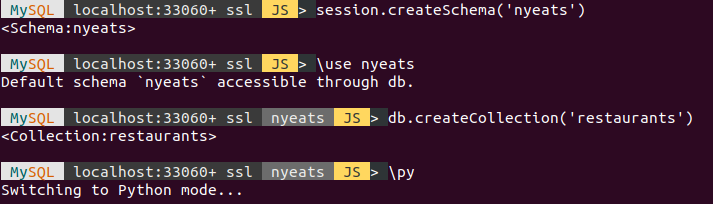
The loading of the JSON data set was covered last time but here is the gist. The first step is to fire up the MySQL Shell and login to the server.

Here a new schema is created and then a new collection

 We need a new schema for this data and the example shows one created as nyeats.  The within that new schema a collection is created with the name restaurants.


[Read more]
Log Buffer #547: A Carnival of the Vanities for DBAs

This Log Buffer edition covers Oracle, SQL Server and MySQL.

Cloud:

What DBAs need to know about Cloud Spanner, Part 1: Keys and indexes

Introducing sole-tenant nodes for Google Compute Engine — when sharing isn’t an option

A serverless solution for invoking AWS Lambda at a sub-minute frequency

Amazon Aurora MySQL DBA Handbook – …

[Read more]
Porting Data From MongoDB to MySQL Document Store in TWO Easy Steps

Porting data from MongoDB to the MySQL Document Store is very easy.  The example I will use is an example data set from the good folks at Mongo named zips.json that contains a list of US Postal Codes and can be found at http://media.mongodb.org/zips.json for your downloading pleasure.

I copied the file into the Downloads directory on my Unbuntu laptop and then fired up the new MySQL Shell.  After login, I created a new schema creatively named zips with session.createSchema('zips').  When then set the db object to this new schema with the command \use zips.

[Read more]
MariaDB Audit Plugin

MariaDB DBAs are accountable for auditing database infrastructure operations to proactively troubleshoot performance and operational issues, MariaDB Audit Plugin is capable of auditing the database operations of both MariaDB and MySQL. MariaDB Audit Plugin is provided as a dynamic library: server_audit.so (server_audit.dll for Windows).  The plugin must be located in the plugin directory, the directory containing all plugin libraries for MariaDB.

MariaDB [(none)]> select @@plugin_dir; 
+--------------------------+
| @@plugin_dir             |
+--------------------------+
| /usr/lib64/mysql/plugin/ |
+--------------------------+
1 row in set (0.000 sec)

There are two ways you can install MariaDB Audit Plugin:

INSTALL SONAME statement while logged into MariaDB, You need to use administrative account which has INSERT privilege for the mysql.plugin table.

MariaDB [(none)]> INSTALL SONAME 'server_audit'; …
[Read more]
MySQL 8.0: Optimizing Small Partial Update of LOB in InnoDB

In this article I will explain the partial update optimizations for smaller (LOBs) in InnoDB. Small here qualifies the size of the modification and not the size of the LOB.  For some background information about the partial update feature, kindly go through our previous posts on this (here, here and here).…

Webinar Weds 6/13: Performance Analysis and Troubleshooting Methodologies for Databases

Please join Percona’s CEO, Peter Zaitsev as he presents Performance Analysis and Troubleshooting Methodologies for Databases on Wednesday, June 13th, 2018 at 11:00 AM PDT (UTC-7) / 2:00 PM EDT (UTC-4).

Register Now


Have you heard about the USE Method (Utilization – Saturation – Errors)? RED (Rate – Errors – Duration), or Golden Signals (Latency – Traffic – Errors – Saturations)?

In this presentation, we will talk briefly about these different-but-similar “focuses”. We’ll discuss how we can apply them to data infrastructure performance analysis, troubleshooting, and monitoring.

We will use MySQL as an …

[Read more]
Character Sets: Migrating to utf8mb4 with pt_online_schema_change

Modern applications often feature the use of data in many different languages. This is often true even of applications that only offer a user facing interface in a single language. Many users may, for example, need to enter names which, although using Latin characters, feature diacritics; in other cases, they may need to enter text which contains Chinese or Japanese characters. Even if a user is capable of using an application localized for only one language, it may be necessary to deal with data from a wide variety of languages.

Additionally, increased use of mobile phones has lead to changes in communications behaviour; this includes a vastly increased use of standardized characters intended to convey emotions, often called “emojis” or “emoticons.” Originally, such information was conveyed using ASCII text, such as “:-)” to indicate happiness – but, as noted, this has changed, with many devices automatically converting such …

[Read more]
PXC loves firewalls (and System Admins loves iptables)

Let them stay together.

In the last YEARS, I have seen quite often that users, when installing a product such as PXC, instead of spending five minutes to understand what to do just run

iptables -F

  and save.

In short, they remove any rules for their firewall.

With this post, I want to show you how easy it can be to do the right thing instead of putting your server at risk. I’ll show you how a slightly more complex setup like PXC (compared to MySQL), can be easily achieved without risky shortcuts.

iptables is the utility used to manage the chains of rules used by the Linux kernel firewall, which is your basic security tool.
Linux comes with a wonderful firewall built into the kernel. As an administrator, you can configure this firewall with interfaces like ipchains  — which we are not going to cover — and iptables, which we shall talk about.

iptables is …

[Read more]
Showing entries 3451 to 3460 of 22619
« 10 Newer Entries | 10 Older Entries »