Wow. Now’s not a good day to announce anything true on your blog. I see a bunch of stuff that probably is true – but who’s banking on that? Is there really a new version of HeidiSQL? Is Arjen really moving to California to do MySQL work? Is Tokutek really purchasing Oracle? Gee, I’m not sure. If I had any thoughts left in my head, I’d make a funny myself, but my head’s pretty empty.
Apr
01
2010
Mar
31
2010
Using ROLLBACK with MyISAM is useless. A ROLLBACK command is used to undo any DML that occurs during a transaction (i.e. START TRANSACTION and COMMIT). The MySQL default storage engine MyISAM does not support transactions.
It is easy with the SHOW GLOBAL STATUS command to see if your application code uses ROLLBACK. By performing two samples you can look at the delta over time. The statpack utility is one product that provides a human friendly display of this delta. As seen below, the use of ROLLBACK in combination with the read/write ratio and the my.cnf –skip-innodb indicate unnecessary database work.
====================================================================================================
                    Variable    Delta/Percentage         Per Second              Total …
[Read more]
Mar
31
2010
For situations where you need an overview on a larger set of
databases, now you have a detailed view in the new
"Databases" tab, left besides the "Variables", "Status" etc. The
new tab displays database names, number of items in them, their
collation, and the summed size of all items in them. Together
with a colored bar and sorting options this should somehow be
helpful in HeidiSQL's mission to make a developer's life
easier:
Mar
31
2010
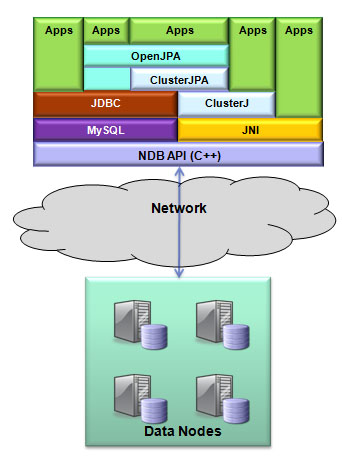
Fig. 1 Java access to MySQL Cluster
This is a follow up to the earlier post Using ClusterJ (part of MySQL Cluster Connector for Java) – a tutorial but covers the ClusterJPA interface rather than ClusterJ.
JPA is the Java standard for persistence and different vendors can implement their own implementation of this API and they can (and do) add proprietary extensions. Three of the most common implementations are OpenJPA, Hibernate and Toplink. JPA can be used within server containers or outside of them (i.e. with either J2EE or J2SE).
Typically a JPA implementation would access the database (for example, MySQL Cluster) using JDBC. JDBC gives a great deal of flexibility to the …
[Read more]
Mar
31
2010
In vBulletin Board System there is session table contains online user information and tracking, in which forum now, what the current URL now, So it is have huge concurrent update statement, By default this table is MEMORY engine because its data not important in case MySQL restart.
I notice early loaded in MySQL and server, So I do full tuning for the server then analyze slow query using
Mar
31
2010
- ZeroMQ -- bold claim of "Fastest. Messaging. Ever." LGPL, C++ with bindings for many languages, past version 2 already. (via edd on Twitter)
- Prediction Market News (David Pennock) -- HSX is going to be a real marketplace with real $. The real HSX will of course say goodbye to the virtual specialist and the opening weekend adjust, two facets of the game that make it fun to play, but that create significant amounts of (virtual) wealth out of thin air. The Cantor Gaming group is engaged in other interesting initiatives. They are taking over a sportsbook in Las Vegas and turning it into more of a derivatives exchange with live in-game betting, a step toward my dream of a geek-friendly casino. …
Mar
31
2010
A colleague pointed me at More fun with the MySQL Audit Plugin API which looks very interesting. Analysis of the queries going on inside a msyqld has been something that has been wanted for some time. Until now it’s only been possible with external addons such as MySQL Enterprise Monitor which do a good job. However, really the place for this functionality is inside the db server itself. If 5.5 m3 provides the hooks to do this that’s great news and while Anders’ first implementation may be simple, this can surely be extended in many ways.
The things I would like to see added to this plugin are the following many of which are safeguards to ensure you can use functionality on a system like this in production without …
[Read more]
Mar
31
2010
In an application such as a database server, instrumentation is like sex: it’s not enough to know how often things happen. You also care about how long they took, and in many cases you want to know how big they were.
“Things” are the things you want to optimize. Want to optimize queries? Then you need to know what activities that query causes to happen. Most systems have at least some of this kind of instrumentation. If you look around at… let’s not pick on the usual targets… oh, say Sphinx, Redis, and memcached. What metrics do they provide? They provide counters that say how often various things happened. (Most of these systems provide very few and coarse-grained counters.) That’s not very helpful. So I read from disk N times, and I read from memory N times, and I compared rows N times… so what? I still don’t know anything relevant to execution time.
That’s why we need to measure how long things took. It’d be …
[Read more]
Mar
30
2010
Mar
30
2010
We just announced VaultPress to the world. You can get your invite here. I’m very excited about this service because it is the first step toward my dream of every WordPress, regardless of where it’s hosted, to have best-in-the-world network (cloud? ) services that take all the worry and hassle away. People invest so much time, money, effort, blood, sweat, and tears into their WordPress-powered sites — they deserve for that to be 100% secure.