Showing entries 1781 to 1790 of 5669
« 10 Newer Entries | 10 Older Entries »
Searching For: gp update (reset)
MaxScale and Transparent Session Handling

Tue, 2015-01-13 10:59vilho_raatikka_l

Applications are often built on top of single MySQL-compliant database instance but often there is a need for more performance and/or availability than what one database instance can provide. Adding slaves or replacing standalone database server with full-fledged MySQL-compliant cluster often requires changes to the application.

MaxScale and its Read Write Split router (rwsplit, for short) attempts to hide the complexity brought by multiple backend servers and to minimize the need for application changes by taking care of authentication, managing connections and providing session management on behalf of the client.

Read Write Split router is a plug-in module, which can be used with MaxScale to receive, examine and forward queries sent by clients. Routing decision is based on query type and some other criteria, such as transaction state, and replication lag. For rwsplit, every cluster …

[Read more]
HowTo: Offline Upgrade of Galera Cluster to MySQL 5.6 or MariaDB 10

MySQL 5.6 has an extensive list of new features and changes, so upgrading from a previous version can be risky if not tested extensively. For this reason, we recommend our users to read and understand the changes before doing the upgrade. If you are on older MySQL versions, it is probably time to think about upgrading. MySQL 5.6 was released in February 2013, that’s almost two years ago!

A major upgrade, e.g., from MySQL 5.5 to 5.6 or MariaDB 5.5 to 10, requires the former MySQL/MariaDB server related packages to be uninstalled. In Galera Cluster, there are two ways to upgrade; either by performing offline upgrade (safer, simpler, requires service downtime) or online upgrade (more complex, no downtime). 


In this blog post, we are going to show you how to perform an offline upgrade on Galera-based …

[Read more]
Using Perl to send tweets stored in a MySQL database to twitter

Twitter is not my favorite social media site. Using twitter is like driving downtown, screaming what you want to say out the window, and hoping someone hears you. There might be tens of thousands of people downtown, but your message will only be heard by a few. Your best bet is to repeat your message as often as possible.

However, twitter is free and if you want to reach as many people (theoretically) as possible, you might as well use it. But sending tweets on a scheduled basis can be a pain. There are client programs available which allow you to schedule your tweets (Hootsuite is one I have used in the past). You can load your tweets in the morning, and have the application tweet for you all day long. But you still have to load the application with your tweets – one by one.

A friend of mine asked me if there was a way to send the same 200 tweets over and over again, spaced out every 20 minutes or so. He has a consulting …

[Read more]
Understanding reservations, concurrency, and locking in Nova

Imagine that two colleagues, Alice and Bob, issue a command to launch a new virtual machine at approximately the same moment in time. Both Alice’s and Bob’s virtual machines must be given an IP address within the range of IP addresses granted to their project. Let’s say that range is 192.168.20.0/28, which would allow for a total of 16 IP addresses for virtual machines [1]. At some point during the launch sequence of these instances, Nova must assign one of those addresses to each virtual machine.

How do we prevent Nova from assigning the same IP address to both virtual machines?

In this blog post, I’ll try to answer the above question and shed some light on issues that have come to light about the way in which OpenStack projects currently solve (and sometimes fail) to address this issue.

Demonstrating the …

[Read more]
Different SSL setups for MySQL

In this blog post I will describe different ways of using SSL with the MySQL database server.

What does SSL give you?

You might use MySQL replication over the internet or connect to MySQL over the internet.

Another posibility is that you connect over an enterprise network to which just too many people have access. This is especially an issue if you use an BYOD network.

SSL helps here by encrypting the network traffic to prevent against evesdropping. It also validates that you're talking to the correct server to prevent man-in-the-middle attacks.

And you can also use SSL client certificates together with an password as two factor authentication.

SSL is not the only option, you could use SSH and many MySQL GUI clients like MySQL Workbench support …

[Read more]
Using YUM to install specific MySQL/Percona Server versions

Sometimes it is desired to use particular software versions in production, and not necessary the latest ones. There may be several reasons for that, where I think the most common is when a new version should spend some time in testing or a staging environment before getting to production. In theory each new version is supposed to be better as usually it contains a handful of bug fixes and even new or improved functionality. However there is also a risk of some regression or a new bug introduction as a side effect of code changes.

Quite often DBAs want the same MySQL version to be installed on all database instances, regardless of what actually is the latest version available in the software provider’s repository. There are several ways to achieve this:
* download specific version packages manually and then install them,
* have custom local repository mirror where you decide when and which version gets there, and just update …

[Read more]
Xtrabackup and MySQL 5.6 on Amazon instance

Have you ever tried to install Xtrabackup on Amazon EC2 instance with Oracle’s MySQL 5.6? Dependencies hell strikes when you ask pretty common and reasonable thing – run the GA version of MySQL and backup it with the most popular open-source tool – XtraBackup. From this post you will learn how to resolve the conflicts and make everybody happy.

mysql55-libs conflicts with mysql-community-libs-5.6.22

A fresh Amazon Linux AMI, 2014.09 EC2 instance comes with MySQL 5.5.40 in amzn-updates repository. Today MySQL 5.5 turns five years old. It’s a good and stable version. But many people want to run MySQL 5.6, because it’s better than 5.5, it supports full-text indexes and Oracle ends support of 5.5 this year.

Oracle distributes MySQL releases via YUM repository. Installing MySQL from the YUM repository is a good idea because YUM takes care of …

[Read more]
Hack MySQL has been retired

After 10 years HackMySQL.com has been retired. The tools are archived at github.com/daniel-nichter/hackmysql.com

I began writing MySQL tools in 2004 because at the time there were none except for mysqldumpslow. I was a Unix sysadmin in a large datacenter, so I worked on many different servers and MySQL instances. Tools for any sufficiently complex system are a necessity. Imagine a car mechanic trying to work without basic tools like an oil filter wrench, torque wrench, or belt tensioner. That's what work with MySQL was like in 2004. Certainly, many people made their own tools, but I think I was the first to develop, document, and publish general-purpose MySQL tools. If I wasn't the first then it's a tie with Baron Schwartz, creator of Maatkit. In 2008 he hired me at …

[Read more]
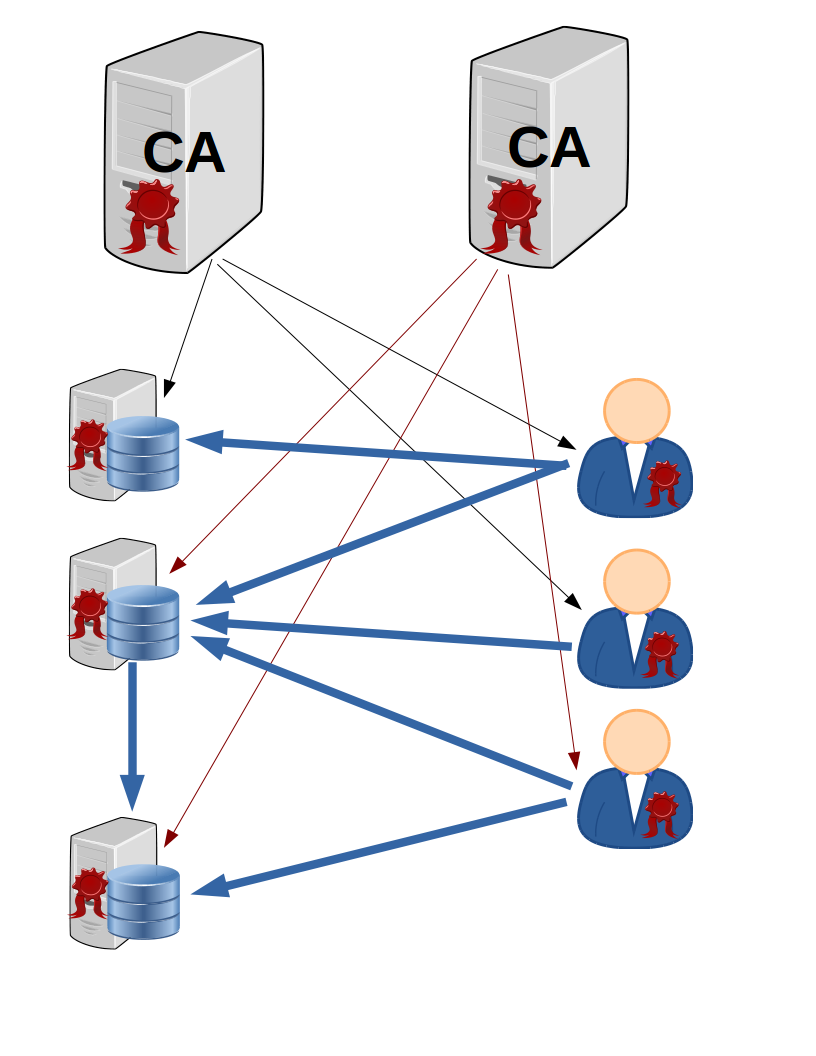
Using a CRL with MySQL

So assume you just uploaded the certificate you use to identify yourself to the MySQL server to Github or some other place it doesn't belong...and there is no undelete.

First: Don't panic.
Often a password is required besides a certificate to connect to the server. So someone with the certificate can't use it without the password. The certificate itself might be protected by a password, but that's really rare. Also access to MySQL and/or your account should be limited to certain IP's.

The next step is to revoke the certificate. This is possible since MySQL 5.6.3 by using a Certificate Revocation List (CRL).
A CRL is a list of the serials of the revoked certificates and signed by the CA. So this will only work if the certificates have unique serials.

[Read more]
How small changes impact complex systems – MySQL example

If you’ve been studying complex systems you know what minor changes might cause consequences of much greater proportions, sometimes causing some effects that are not easily explained at first. I recently ran across a great illustration of such behavior while doing MySQL benchmarks which I thought would be interesting to share.

I’m using a very simple benchmark – Sysbench 0.5 on Percona Server 5.6.21-70.1 just running update queries:

sysbench  --num-threads=64 --report-interval=10 --max-time=0 --max-requests=0 --rand-type=pareto --oltp-table-size=1000000000 --mysql-user=root --mysql-password= --mysql-db=sbinnodb  --test=/usr/share/doc/sysbench/tests/db/update_index.lua run

Some people frown upon such benchmarks due to their triviality and being irrelevant to workloads. I like them because they often allow you to study already complex system behavior in a much more controlled environment than “real” workloads – and so …

[Read more]
Showing entries 1781 to 1790 of 5669
« 10 Newer Entries | 10 Older Entries »