Showing entries 331 to 340 of 515
« 10 Newer Entries | 10 Older Entries »
Displaying posts with tag: MySQL Cluster (reset)
MySQL Cluster Manager 1.1 available!

As the title of this post suggests, MySQL Cluster Manager 1.1 is now available – but this actually has a double meaning:

  1. MySQL Cluster Manager 1.1 is GA (I’ll explain below the major improvements over 1.0)
  2. Everyone is now able to download and try it (without first having to purchase a license)!

This software is only available through commercial licenses (i.e. not GPL like the rest of Cluster) and until recently there was no way for anyone to try it out unless they had already bought MySQL Cluster CGE; this changed on Monday when the MySQL software became available through Oracle’s E-Delivery site. Now you can download the software and try it out for yourselves (just select “MySQL Database” as the product pack, select your …

[Read more]
Pushed down JOINs - Webinar

On Thursday, November 04, at 0900PST/1700CET/1600GMT there is a webinar about Pushed Down Joins. This webinar will explain how Pushed Down Joins works, and some performance numbers.
Register here: http://mysql.com/news-and-events/web-seminars/display-583.html.

NDB Pushed JOINs means query shipping instead of data shipping and it reduces drastically the network hops between the MySQL Server and data nodes, which in turn gives a tremendous performance improvement. For particular queries a 180x improvement has been measured.

MySQL Cluster Demo from Oracle OpenWorld

If you weren’t able to attend Oracle OpenWorld or didn’t get chance to  visit the MySQL demo booths then you can watch a recording of the demo here. The video gives a brief description of MySQL Cluster and then dives into a series of demos showing MySQL Cluster’s ability to cope with a number of events without losing service – including node failure, on-line upgrades and on-line horizontal scaling.

To view a higher quality version click here.

Glimpse of the future – massively improved JOIN performance for MySQL Cluster

MySQL Cluster Push-Down Joins

A great chance to find out about the “SPJ” project that’s under way to improve the performance of complex table JOINs. A free webinar has been scheduled for Thursday, November 04 at 09:00 Pacific time (16:00 UK; 17:00 Central European Time) – just register for the webinar at mysql.com. Even if you can’t attend, by registering you’ll get an email telling you where to watch the replay shortly after the webinar.

MySQL Cluster performance has always been extremely high and scalable when the work load is primarily primary key reads and write but complex JOINS (many tables in the JOIN and/or a large number of results from the first part of the query) have traditionally been much slower than when using …

[Read more]
In Pursuit of the Holy Grail - MySQL Cluster and Push Down JOINs

UPDATE - 15TH NOVEMBER
An on-demand replay of the webinar discussed below is available from the following URL:
http://www.mysql.com/news-and-events/on-demand-webinars/display-od-583.html

The development team would highly value feedback on your experience with the Push Down Joins project, and whether any current limitations prevent you from using this functionality.
Please send feedback or questions via the following mailing list:
spj-feedback@sun.com

You can access the binary (Linux-only) and source here:
ftp://ftp.mysql.com/pub/mysql/download/cluster_telco/mysql-5.1.51-ndb-7.1.9-spj-preview/

ORIGINAL BLOG POSTING:
Ok, so the title maybe a little melo-dramatic, but for those who work with databases that distribute tables and rows across multiple nodes, pursuing the holy grail may not be that far from the truth.

We are running a live …

[Read more]
New white paper – MySQL Replication – Enhancing Scalability and Availability with MySQL 5.5

MySQL Replication from 1 Master to Multiple Slaves

A new white paper has been published that covers MySQL Replication – background information, how it works, how to use it and what’s new in MySQL 5.5. Simply register for the white paper at mysql.com and you’ll be sent your free copy.

The paper starts by covering the fundamental concepts behind replication such as the difference between synchronous and asynchronous replication and the idea behind semisynchronous replication.

It goes on to describe the common use-cases for replication – scaling out, high availability, geographic redundancy and offloading backups or analytics.

Various replication topologies are discussed from simple master-slave …

[Read more]
MySQL Cluster 7.1.8 binaries released

The binary version for MySQL Cluster 7.1.8 has now been made available at http://www.mysql.com/downloads/cluster/

A description of all of the changes (fixes) that have gone into MySQL Cluster 7.1.8 (compared to 7.1.5) can be found in the official MySQL Cluster documentation.

MySQL Cluster - Performance (UPDATE on PK) - >120K updates/sec

This post follows on the previous post on SELECT performance. In this post I want to show three things:

  1. How many single row UPDATEs per second you can do on on a Cluster with two data nodes (updating 64B data by the PRIMARY KEY, no batching)
  2. Show how MySQL Cluster scales with threads and mysql servers
  3. How ndb_cluster_connection_pool affects performance

Next post will be what happens to INSERTs.

Setup

  • two data nodes
  • one to four mysql servers
  • interconnected with Gig-E (single NIC)

deployed on six computers (of varying quality, but not really modern, see below). www.severalnines.com/bencher was co-located with each mysql …

[Read more]
Free webinar: Delivering Scalability and High Availability with MySQL 5.5 Replication Enhancements

Simple Master -> Slave Replication


MySQL 5.5 (currently at Release Candidate status) introduces a lot of enhancements to replication, making it even more robust and easy to manage. At 9:00 am PST (5:00 pm UK, 6pm CET) you have the chance to hear the details from the replication development manager (Dr Lars Thalmann) as well as get some of your replication questions answered.

As always, attendance is free but you must click here to register in advance.

Get MySQL Replication up and running in 5 minutes

MySQL Replication is incredibly simple to get up and running and this (short) post steps you through it.
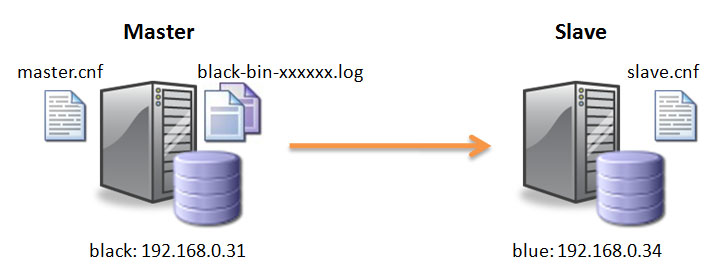
Simple Master -> Slave Replication

MySQL allows you to build up complex replication hierarchies, such as multi-master, chains of read slaves, backup databases at a remote site or any combination of these. This post focuses on a simple single master to single slave topology – the more complex solutions are built from this basic building block.

This post also makes the assumption that the 2 MySQL Servers have been installed but that there is no existing data in the master that needs to be copied to the slave – it’s not complex to add that extra requirement and it will be covered in a future post.

Server “black” (192.168.0.31) is to be our master and “blue” (192.168.0.34) the slave.

[Read more]
Showing entries 331 to 340 of 515
« 10 Newer Entries | 10 Older Entries »