Community journal

The latest from the MySQL community

Ideas, releases, practical guides, and perspectives from the people building with MySQL.

Follow the feed
Showing entries 3241 to 3250 of 45460 « Previous | Next »
The MySQL Shell and the MySQL Config Editor

    One of the things I love about the MySQL Shell is that is saves your authentication credentials (no longer just passwords) in an obfuscated login path file named .mylogin.cnf. You can find that file in the %APPDATA%\MySQL directory on Windows or the current user's home directory on non-Windows systems. The file can be read later by MySQL client programs, such as the MySQL Shell, to obtain your authentication credentials for connecting to MySQL Server.

Which Credentials?

I had an email this morning from someone wanting to a) change the password stored by mysqlsh and b) find out which credentials are stored on the shell account being used.

Let's start out in reverse order.  The mysql_config_editor will show you the accounts with credentials saved for that login. 

$ mysql_config_editor print --all
[root@localhost]
user = "root"
password = …
[Read more]
Oracle MySQL Scores Big Race Victory at Silverstone

GT Cup 2021 For racing, as for the cloud, performance matters; and a few second faster will make a difference between win and lose. Team Greystone GT and Oracle MySQL Database Service with HeatWave score maiden race win with Mason and Lancaster in GT Cup Greystone GT became race winners for the firs...

Discovering MySQL Database Service – Episode 5 – Create a MySQL DB system from a MySQL Shell dump

MySQL, the world’s most popular open source database, is available as a managed cloud service in Oracle Cloud Infrastructure (OCI) under the name of MySQL Database Service (MDS).

This is the fifth episode of “Discovering MySQL Database Service“, a series of tutorials where I will show you, step by step, how to use MySQL Database Service and some other Oracle Cloud Infrastructure services.

In this episode, we’ll see how these data can now easily be imported into a MySQL Database Service instance.

The post Discovering MySQL Database Service – Episode 5 – Create a MySQL DB system from a MySQL Shell dump first appeared on dasini.net - Diary of a MySQL expert.

APEX App Creator Spotlight: Michelle Skamene’s Reading Rewards promotes literacy to children around the world

Oracle APEX App Creator Spotlight: Michelle Skamene invented Reading Rewards to encourage her children to read. Now the app is used by students around the world.

APEX App Creator Spotlight: Michelle Skamene’s Reading Rewards promotes literacy to children around the world

Oracle APEX App Creator Spotlight: Michelle Skamene invented Reading Rewards to encourage her children to read. Now the app is used by students around the world.

APEX App Creator Spotlight: low-code automation saves scores of administrative hours for professional training business

In our first APEX app creator spotlight, we take a look at two ingenious apps Hesham built with APEX.

APEX App Creator Spotlight: low-code automation saves scores of administrative hours for professional training business

In our first APEX app creator spotlight, we take a look at two ingenious apps Hesham built with APEX.

Point-in-Time Recovery in OCI MDS with Object Storage – part 2

In part 1 of the series about Point-in-Time Recovery in OCI MDS, we saw how to stream the binary log to Object Storage.

In this blog post, we will see how we can restore the data up to certain point.

The high level process is simple:

  1. we need to restore the last backup just before the point we want to return to
  2. find the last GTID that was executed in that backup (not 100% mandatory but can accelerate the process)
  3. choose what is the objective:
    1. just skip one transaction (following transaction could depend on it)
    2. recover up to that transaction and skip all the following ones
  4. replay the binary logs taking in consideration the chosen option of point 3

The scenario …

[Read more]
Point-in-Time Recovery in OCI MDS with Object Storage – part 1

To setup point-in-time recovery for MDS using Object Storage, these are the prerequisites:

  • a MDS instance running
  • a backup plan (default)
  • a compute instance
  • an Object Storage Bucket

In this article, I won’t focus on how to create a MDS instance, a compute instance, enable backups and Object Storage Bucket, this is easy and there is already a lot of literature about them (you can also check several of my previous articles).

This is part 1 of the Point-in-Time Recovery in OCI MDS series. It’s only about streaming the binary logs to Object Store. In part 2, we will see how to use them and perform PITR.

Saving the binary logs

In fact most of the work will be to setup the compute instance to store the binary logs coming from MDS (one single compute instance could stream those binlogs from multiple MDS source).

On the compute instance we need …

[Read more]
Codership Releases Galera Manager to easily deploy and manage Galera Clusters on premise and in Amazon Web Services

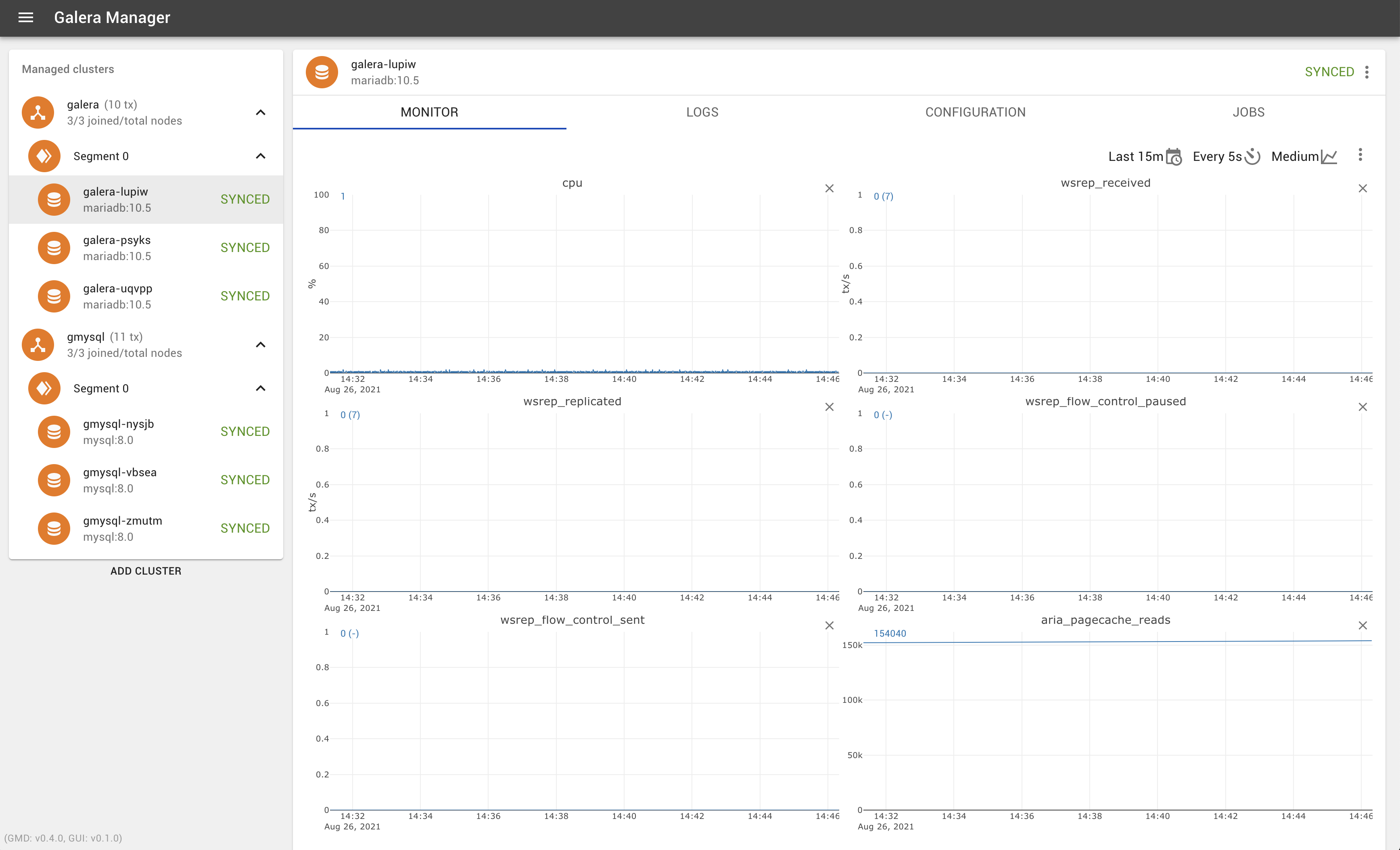
Codership, the leading MySQL High Availability clustering solutions company behind Galera Cluster, is pleased to announce the general availability of Galera Manager, a web-based graphical user interface (GUI) tool to easily deploy and manage your Galera Clusters. With today’s release, you can now create fully managed clusters in Amazon Web Services, you can also deploy clusters on user provided hosts (on premise or in the cloud) and you can also fully monitor your existing clusters.

We now have the concept of a managed node (your typical MySQL instance) and managed host (your typical Linux instance) which you use to deploy Galera Cluster in Amazon EC2, a managed node and a monitored host for user provided hosts (on premise or …

[Read more]