As Tomas announced in his keynote at MySQL Connect 2013, we are
working on a brand new product called MySQL Fabric. Along with
this release of MySQL Fabric, we are releasing Connector/J 5.1.26
with Fabric support on labs.mysql.com. This is an alpha-quality
release that adds support for scalability features in MySQL
Fabric. Sharding and read/write splitting are the initial
features supported by Connector/J.
In a setup involving read/write splitting or customized sharding,
we generally have to duplicate knowledge of this configuration in
the client applications. This is done in connection strings
specified in configuration files or directly in code. With MySQL
Fabric, we can express our system-wide configuration of database
servers in a way that it can be accessed by client applications.
In cases where this needs to change (and it always does..), the
configurations affecting client applications no longer need to be
changed. The connector will …
MySQL-5.6 was our best release ever and we
are happy to see people praising it. This motivates us to work
even harder for our next release. MySQL-5.7.2 DMR is out and we have already got a
number of MySQL replication features. Below is a list of these
features:
- mysqlbinlog idempotent mode
- mysqlbinlog --rewrite-db option
- Dump thread does not take binary log
lock
- …
Introduction Enterprises often start with a single server
setup.
As the enterprise grows, so does the data and the number of
requests for the data. Using a single server setup makes it
difficult to manage the increasing load. This creates the
requirement to scale out.
One solution would be to replicate to read servers. The writes go
to the master and the reads go to the slaves.
Although this setup handles the
increased read load, it still cannot handle the increasing write
load. Trying to handle this by adding another master just
compounds the problem. The write load must be repeated on every
master (more work for the application and each master is just as
busy as if …


As you saw on the keynote, we are introducing an integrated
framework for managing farms of MySQL servers with support
for both high-availability and sharding. It should be noted that
this is a very early alpha and that it at this point is not ready
for production use.
MySQL Fabric is an integrated system for managing a collection of
MySQL servers and is the framework on which high-availability and
sharding is built. MySQL Fabric is open-source and is intended to
be extensible, easy to use, and support procedure execution even
in the presence of failure, an execution model we call
resilient execution.
To ensure high-availability, it is necessary to have redundancy
in the system. For database systems, the redundancy traditionally
takes the form of having a primary server acting as a master and
using replication to keep secondaries available to take over in
case the primary fails. This means that the "server" …
With today’s announcement of the second MySQL 5.7 Development Milestone Release and a new labs release it’s a very exciting time for MySQL Replication. MySQL 5.6 contained a lot of new content to make replication faster, easier to use and more reliable (Global Transaction Identifiers, Multi-Threaded Slaves, Binary Log Group Commit, Optimized Row Based Replication, Crash Safe Replication, Replication Event Checksums, Time Delayed Replication & Informational Logs) and now we want to improve things even further.
The new DMR has something for everyone.
With the improvements to Semi-Synchronous Replication, the application developer can be confident that when a transaction has been …
[Read more]
MySQL Replication is based on a master-slave architecture, where
updates on the master are propagated to the slave through
binary log events via a communication channel (aka a
network connection). A slave would have been able to connect
to only a single master at a time. If a slave wanted to
receive updates from several masters, there were a few choices
possible:
- Time sharing replication, where a slave would connect to a master for a particular time slice. (See, Mats blog here )
- Have a hierarchical replication, where a slave that is to receive updates from the several masters is at the end of replication hierarchy. ( Like, M1->M2->M3->Slave)
- Using several instances of mysqlbinlog + GTIDs. (See Luis blog …
Yes, we've done it! ;-)
Tomas just announced we've reached 500K QPS performance
level in OLTP_RO Point-Selects 8-tables benchmark, and I may only
confirm it and say you little bit more:
This is the best-to-best comparison between the all listed
engines obtained on the same 32cores-HT server that I've used in
my previously published benchmark results. Same
workload, same conditions, updated players. All details about
this and other tests results I'll provide during my tomorrow's talk at MySQL Connect conference
(11:30AM), and then later publish them within another blog post..
Well, what else to say.. - MySQL 5.7 is preparing to become the next …
[Read more]
Applications should be written taking into account that errors
will eventually happen and, in particular, database application
developers usually consider this while writing their
applications.
Although the concepts required to write such applications are
commonly taught in database courses and to some extent are widely
spread, building a reliable and fault-tolerant database
application is still not an easy task and hides some pitfalls
that we intend to highlight in this post with a set of
suggestions or tips.
In what follows, we consider that the execution flow in a
database application is characterized by two distinct phases:
connection and business logic. In the connection phase, the
application connects to a database, sets up the environment and
passes the control to the business logic phases. In this phase,
it gets inputs from a source, which may be an operator, another
application or a component within the same …
In this post, we are going to show how to develop fault-tolerant
applications using MySQL Fabric, or simply Fabric, which
is an approach to building high availability sharding
solutions for MySQL and that has recently become available
for download as a labs release (http://labs.mysql.com/). We are going to focus
on Fabric's high availability aspects but to find out more on
sharding readers may check out the following blog post:
Servers managed by Fabric are registered in a MySQL Server instance, called backing store, and are …
[Read more]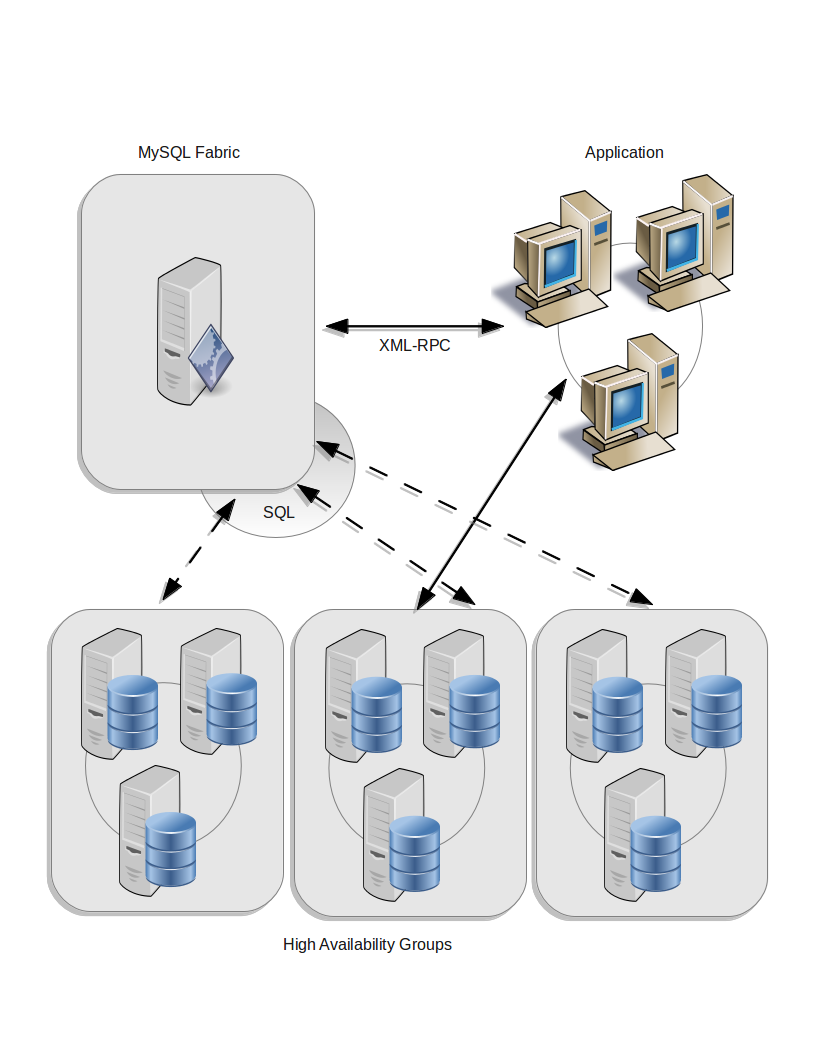
In MySQL we have the typical behaviour that we open and close connections very often and rapidly. So we have very short-living connections to the server. This can lead in extreme cases to the situation that the maximum number of TCP ports are exhausted.
The maximum number of TCP ports we can find with:
# cat /proc/sys/net/ipv4/ip_local_port_range
32768   61000
In this example we can have in maximum (61000 - 32768 = 28232) connections concurrently open.
When a TCP connections closes the port cannot be reused
immediately afterwards because the Operating System has to wait
for the duration of the TIME_WAIT interval (maximum
segment lifetime, MSL). This we can see with the command:
# netstat -nat

Active Internet connections (servers and established)
Proto Recv-Q Send-Q Local Address               Foreign Address             State
tcp        0      0 0.0.0.0:10050 …
[Read more]