Showing entries 27241 to 27250 of 44917
« 10 Newer Entries | 10 Older Entries »
Sun, Is GPL FUD A Standard Business Practice?

As The Clash reminded us, Know Your Rights!

A good friend whom I trust implicitly recently told me of a disturbing conversation that had taken place between a DBA acquaintance friend of his and a Sun sales engineer. Disturbing enough that it prompts me to remind everyone what your rights and obligations are when you use the community edition of MySQL that is licensed under the GPLv2.

Apparently, this friend of a friend needed some performance tuning done on a MySQL Community Edition installation that spans several servers, and serves up their proprietary, commercial web application. They contacted Sun in order to see …

[Read more]
Seeking experienced C++ developer for a MySQL script

I’ve started work on a c++ version of the Kontrollbase client script but am not as experienced in c++ as I’d like to be and don’t have the time to learn more c++ at the moment. The idea being that the client script written in perl has a lot of module dependencies and that complicates rolling out the client to large server farms. A compiled C++ script will be a drop-in solution.

So, if someone that is talented with c++ on Linux wants to help out the project and write a quick script involving a connection to mysql to run queries, and then connect to SNMP to gather system information, then export all of that to stdout as XML… let me know! I already have the MySQL part outputting XML so we just need the SNMP part and some error checking. Email me at themattreid at gmail dot com or commetnt on this post if interested. You’ll get credit on the project as a contributor.

Fractal Trees May Be Useful for Making Energy-Efficient Databases

On April 9-10 the National Science Foundation hosted the Workshop on the Science of Power Management (SciPM 2009), where I gave an invited talk. Here I give a brief summary of my talk along with a pointer to the slides.

The talk describes how MySQL with TokuDB can provide a path to more energy-efficient database implementations. It’s a theoretical talk. That is, rather than presenting results from an existing implementation, it provides food for thought about future possibilities.

Here’s an executive summary of the talk.

Disks use a substantial fraction of the computing power in a typical database application. Although different workloads and configurations can give very different values, somewhere around 1/3 to 2/3 of the total energy consumed by the computing unit seems like a good …

[Read more]
Want to spend a weekend in Germany talking about Databases?

If so, you should check out OpenSQLCamp 2009, European Edition. November last year, the home of OpenSQL Camp was Charlottesville, VA, but now it is time to have something a bit more local. OpenSQL Camp will take place Saturday 22nd and Sunday 23rd of August, in St. Augustin, Germany, so it could do for a nice August getaway to Germany.

It’s not really the biggest of cities, but then again, that is part of the charm, going to some small city and learning more about databases.
In case you do happen to be curious, feel free to check out the list of proposed sessions, although it is not complete, it does give a overview of what to expect.

I for one am looking forward to a European event, as it seems like most things is based in the US, and that means travel time will be less and no …

[Read more]
Intelligent user-controlled partitioning and writing distribution-aware NDB API Applications

Default partitioning

By default, Cluster will partition based on primary key

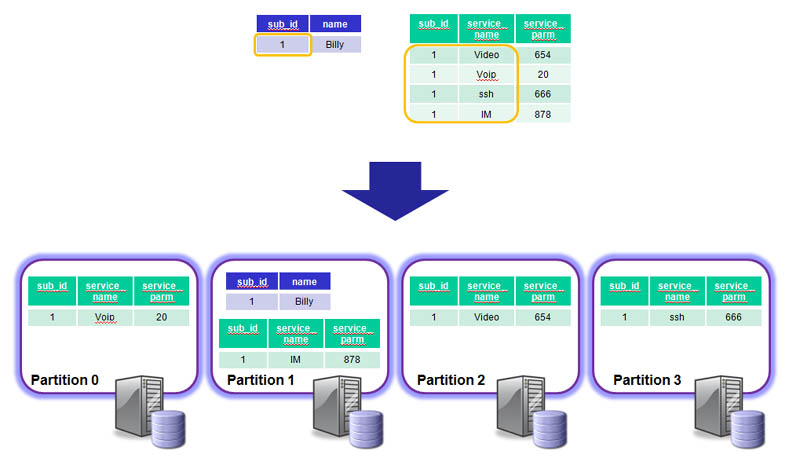
When adding rows to a table that’s using MySQL Cluster as the storage engine, each row is assigned to a partition where that partition is mastered by a particular data node in the Cluster. The best performance comes when all of the data required to satisfy a transaction is held within a single partition so that it can be satisfied within  a single data node rather than being bounced back and forth between multiple nodes where  extra latency will be introduced.

By default, Cluster partions the data by hashing the primary key. This is not always optimal.

For example, if we have 2 tables, the first using a single-column primary key (sub_id) and the second using a composite key (sub_id, service_name)…

mysql> …
[Read more]
Just do the math!

One of the most typical reasons for performance and scalability problems I encounter is simply failing to do the math. And these are typically bad one because it often leads to implementing architectures which are not up for job they are intended to solve.

Let me start with example to make it clear. Lets say you're doing some reports from your apache log files - how many distinct visitors hit the page and stuff like that. You picked full logs because they are great in flexibility - you can run any adhoc queries and drill down as much as you like. Initially traffic was small and young and with 10000 page views a day you few days of history the queries there instant which gave you a confidence this approach will work.

As the time passes and you get 1.000.000 events per day and looking to do reporting for up to the whole year worth of data you find things not working any more with response times for individual queries taking half an …

[Read more]
Fractal Trees May Be Useful for Making Energy-Efficient Databases

On April 9-10 the National Science Foundation hosted the Workshop on the Science of Power Management (SciPM 2009), where I gave an invited talk. Here I give a brief summary of my talk along with a pointer to the slides.

The talk describes how MySQL with TokuDB can provide a path to more energy-efficient database implementations. It’s a theoretical talk. That is, rather than presenting results from an existing implementation, it provides food for thought about future possibilities.

Here’s an executive summary of the talk.

Disks use a substantial fraction of the computing power in a typical database application. Although different workloads and configurations can give very different values, somewhere around 1/3 to 2/3 of the total energy consumed by the computing unit seems like a good …

[Read more]
dbForge Fusion 3.50 released! Enjoy more valuable features!

Devart has released today the updated version 3.50 of dbForge Fusion for MySQL – a powerful add-in for Microsoft Visual Studio or CodeGear RAD Studio, designed to simplify MySQL database development and enhance data management.

Up to 100 usability improvements have been implemented, so you get better insight and satisfaction as well as a total control over performed tasks through the modernized UI of dbForge Fusion for MySQL.

Striving to speed up performed tasks, dbForge Fusion offers compression to reduce traffic, while exchanging data with MySQL server, and makes the exchange quicker.

The new features of dbForge Fusion for MySQL 3.50 include:

A new excellent Database Designer

The new version includes a modern tool for online database design – Database Designer. It is indispensable for anyone who needs to build a clear and …

[Read more]
My MySQL wishlist (revised)

I wrote about my MySQL wishlist on November 14th 2007 and now it's time for an update. I will copy-paste the old entry. The original text will be in italics.

1. Per user and/or per database quota
Would very useful in setups for shared hosting. This would also prevent one database from bringing down the whole server. Separate tablespaces on different mountpoint can ease the pain, but I consider that a nasty hack.

No update. Still problematic

2. External authentication
I've seen numerous scripts which fetch the authentication info from ldap, a file, another database or some other authentication store. This should be integrated into mysql. The mysql grant tables should be pluggable so it is possible to write a custom authentication plugin. We already have plugable engines and function (UDF) so this shouldn't be that hard …

[Read more]
My MySQL wishlist (revised)

I wrote about my MySQL wishlist on November 14th 2007 and now it's time for an update. I will copy-paste the old entry. The original text will be in italics.

1. Per user and/or per database quota
Would very useful in setups for shared hosting. This would also prevent one database from bringing down the whole server. Separate tablespaces on different mountpoint can ease the pain, but I consider that a nasty hack.

No update. Still problematic

2. External authentication
I've seen numerous scripts which fetch the authentication info from ldap, a file, another database or some other authentication store. This should be integrated into mysql. The mysql grant tables should be pluggable so it is possible to write a custom authentication plugin. We already have plugable engines and function (UDF) so …

[Read more]
Showing entries 27241 to 27250 of 44917
« 10 Newer Entries | 10 Older Entries »