Showing entries 1711 to 1720 of 5669
« 10 Newer Entries | 10 Older Entries »
Searching For: gp update (reset)
Updating MySQL on Ubuntu 12.04 LTS to MySQL 5.6

The Ubuntu 12.04.3 LTS release only provides MySQL 5.1 and MySQL 5.5 using the default Ubuntu package manager.

Oracle (owners of the MySQL(tm)) now provide Debian/Ubuntu APT repositories for all GA and DMR versions of MySQL including supporting Ubuntu 12.04.

The following steps demonstrate upgrading from the Ubuntu 5.5 server package to the Oracle 5.6 server package.

Verify MySQL Packages

$ apt-cache search mysql-server
mysql-server - MySQL database server (metapackage depending on the latest version)
mysql-server-5.5 - MySQL database server binaries and system database setup
mysql-server-core-5.5 - MySQL database server binaries
auth2db - Powerful and eye-candy IDS logger, log viewer and alert generator
cacti - Frontend to rrdtool for monitoring systems and services
torrentflux - web based, feature-rich BitTorrent download manager

Verify …

[Read more]
Stop using FLUSH PRIVILEGES

Mermaids have the same probability of fixing your permission problems, but people continue believing in the FLUSH PRIVILEGES myth.I see suggesting the usage of FLUSH PRIVILEGES every time someone writes a tutorial or a solution to a problem regarding creating a new account or providing different privileges. For example, the top post on /r/mysql as of the writing of these lines, “MySQL:The user specified as a definer does not exist (error 1449)-Solutions” has multiple guilty cases of this (Update: the user has corrected those lines after I posted this article).

It is not my intention to bash that post, but I have seen …

[Read more]
State Of The Storage Engine - DZone

I contributed an article on modern database storage engines to the recent DZone Guide To Database and Persistence Management. I’m cross-posting the article below with DZone’s permission.

Readers of this guide already know the database world is undergoing rapid change. From relational-only, to NoSQL and Big Data, the technologies we use for data storage and retrieval today are much different from even five years ago.

Today’s datasets are so large, and the workloads so demanding, that one-size-fits-all databases rarely make much sense. When a small inefficiency is multiplied by a huge dataset, the opportunity to use a specialized database to save money, improve performance, and optimize for developer productivity and happiness can be very large. And today’s solid-state …

[Read more]
State Of The Storage Engine - DZone

I contributed an article on modern database storage engines to the recent DZone Guide To Database and Persistence Management. I’m cross-posting the article below with DZone’s permission.

Readers of this guide already know the database world is undergoing rapid change. From relational-only, to NoSQL and Big Data, the technologies we use for data storage and retrieval today are much different from even five years ago.

Today’s datasets are so large, and the workloads so demanding, that one-size-fits-all databases rarely make much sense. When a small inefficiency is multiplied by a huge dataset, the opportunity to use a specialized database to save money, improve performance, and optimize for developer productivity and happiness can be very large. And today’s solid-state …

[Read more]
Deprecating Weaker Encryption Functions

A Quick Security Update

Starting with MySQL 5.7.6, the following functions are now deprecated:

DES (Data Encryption Standard) is known to be less secure and slower than other available encryption methods. There are also many …

[Read more]
How to Deploy and Configure MaxScale for SQL Load Balancing with Read-Write Split

There are two models of load balancing: transport and application layer. HAProxy is a great TCP load balancer, but it’s lack of SQL awareness effectively limits its ability to address certain scaling issues in distributed database environments. In the open source world, there’s been a few SQL-aware load balancers, namely MySQL Proxy, ProxySQL and MaxScale, but they all seemed to be in beta status and unfit for production use. So we were pretty excited when the MariaDB team released a GA version of MaxScale earlier this year. In this blog, we’ll have a look at MaxScale and see how it compares with HAProxy.

Deployment

Installation is easy, at least on the latest LTS version of Ubuntu (Trusty, 14.04) which we used …

[Read more]
Fedora Install LAMP

My students wanted an extra credit assignment, so I thought a LAMP configuration and test would be appropriate. The only problem was I hadn’t added it to their course VMware instance. So, here are the instructions to install Apache2, PHP, and MySQLi for a complete LAMP stack when MySQL is already installed.

The post builds on my Fedora Install of MySQL and MySQL Workbench on Fedora posts from last year. It also presumes that you’ve installed a studentdb database but you need to know how to do that let me know (but it hasn’t changed much from the example at the bottom of this old MySQL 5.1 blog post).

You …

[Read more]
Paramiko Update Tutorial

There are situations when you need to update the python-paramiko library that is bundled with MySQL Workbench. This may be because you prefer
using the latest cutting edge versions, are just curious, or you can’t wait for a new Workbench version.

To update, first download the latest python-paramiko release from https://github.com/paramiko/paramiko/releases. After downloading and extracting the archive, you’ll see a paramiko folder inside of the extracted folder. This folder needs to be copied into the appropriate MySQL Workbench folder on the system.

* For Windows, this location is usually
WB_INSTALLDIR/python/site-packages/paramiko

* For OS X, this will be
/Applications/MySQLWorkbench.app/Contents/Resources/Libraries/paramiko

* For Linux, you should use your repository manager (yum, apt-get, etc.), but …

[Read more]
MariaDB: The Differences, Expectations, and Future

Thu, 2015-03-26 07:48russelljtdyer

For my new book, Learning MySQL and MariaDB, Monty Widenius, one of the founders of MySQL and MariaDB, graciously contributed a Foreword. It's about six pages long and an interesting read for those who are familiar with MySQL and MariaDB. Of particular interest to newcomers to MariaDB, is the excerpt below on his perspective of MariaDB and his vision for its future, as well as MySQL.

Excerpt from Foreword of Learning MySQL and MariaDB (O'Reilly 2015)

"Regarding my hopes and expectations for the MariaDB database system, I’m working at the foundation to ensure that we get more companies actively involved in the development of MariaDB. That’s something …

[Read more]
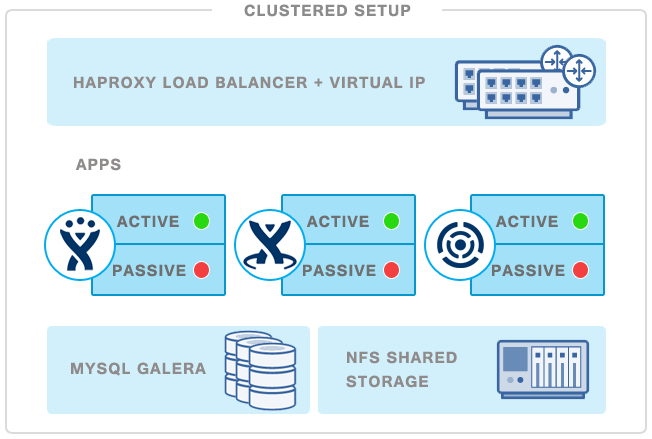
How to Cluster Atlassian Server Apps in your Data Center - JIRA, Confluence, Stash with MySQL Galera Cluster

Atlassian apps are widely used by development teams to facilitate software development and collaboration. For larger teams who require enterprise-grade tools, you might want to host the applications in your own data center and cluster them for high availability and performance. 

In this blog post, we are going to deploy a redundant active-passive setup for JIRA with clustered MySQL and NFS shared storage. Note that some Atlassian applications (JIRA, Confluence and Stash) already has built-in clustering support, and these require you to have a Data Center license. In this blog, we will show you how to cluster the regular/standalone JIRA server product by deploying an active JIRA server with an additional passive stand-by instance for failover purposes.

The following is our architecture diagram:

[Read more]
Showing entries 1711 to 1720 of 5669
« 10 Newer Entries | 10 Older Entries »