The first "barbecue" of the PHP BBQ tour has been held in Munich. A little more than 30 attendees came to the Hirschgarten restaurant. Unfortunately we could not have a BBQ due to bad weather. Nonetheless the event has been a success: for some it has been the first PHP community event. And, of course, you always meet and greet "countless" well known PHP hackers. Let me name only two of them: Johannes Schlueter, who helped to organize the event and Pierre Joye (and Jana and Spooky), my host. Credits also go to Johann-Peter Hartmann from Mayflower, Nils Hitze and …
[Read more]
Jun
16
2009
Jun
16
2009
|
|
I will be in Madrid on June 18-19, to participate to the Sun Open Communities Forum. I will have two presentations on my own, and I will be a guest speaker during Victor Jimenez's session. There will be some ancillary activities, among which a lunch with the MySQL community and a MySQL workshop. |
During one of these activities, I will give away one copy of the
MySQL Administrator’s Bible. If you are a
MySQL enthusiast and you are in Madrid, that's an extra reason to
attend the forum. For the ones who still don't know how …
Jun
16
2009
Something I’ve added to BlitzDB recently that was pretty high on my todo list is support for variable width tables. So what is a variable width table? it is a table that contains columns that can vary in size, namely BLOB and TEXT types.
Going back to the basics, when a new row is to be written, a storage engine is given a pointer to the row data in MySQL format that it must somehow store for later lookup/retrieval. By meaning “somehow”, the storage engine is given the freedom to do whatever it likes with the row.
Writing a row for a fixed length table (a table with columns that are always the same size) is deadly easy. A storage engine can choose to not temper with the row and simply write or copy the data to it’s storage mechanism. This is because the storage engine is given a row that contains all the data. Rows for variable width tables …
[Read more]
Jun
16
2009
Yesterday we held our PHP BBQ event at Munich, well it was no BBQ as the weather forecasts predicted rain,which came in the evening, but a nice evening in a beer garden.
We had more than 30 people there, some leaving early, sme arriving late, covering quite different kinds of participants: PHP core developers, professional PHP users, people doing PHP stuff as hobby, friends and PHP community veterans like Till Gerken. Many people didn't know each other or didn't see each other or some time so we had lot's of discussions, and most of them even weren't about PHP and even many non-IT things were covered, which I find always great. If you want an impression check Ulf's photos. I really hope this makes a good foundation for more regular PHP meetups.
There will be a few more events of this kind this week in Germany, so go there if you can, don't be …
[Read more]
Jun
16
2009
I uploaded all of my past presentations to Slideshare recently, and realized that I hadn’t actually posted some of these on my blog in the past as well.
So I’ve created a new Presentations Page that has all of these together now.
It’s kind of funny to see the “MySQL for Oracle DBAs” presentation again - a lot has changed since 2006!
In any case, enjoy if you haven’t seen them - give them a look over if interested, and feel free to post comments or questions on the page!
Jun
16
2009
The ibdata file is too big 10GB, and actually we've only about 2GB (data+index) in innodb storage engine.How we can defragment this file and reduce it?How is this happened?By default the ibdata file created initially by (innodb_data_file_path = ibdata1:10M:autoextend) and auto extended by (innodb_autoextend_increment = 8MB) when it’s needed, and this file (tablespace) contain all innodb tables (
Jun
16
2009
Of course, it’s just a joke, but in every joke there is a grain of joke. Remember how many times you wished you never saw Database Explorer again, switching from the SQL script each time to view a required database object. It is really inconvenient to search database objects mentioned in the script using Database Explorer.
Your way out is one-click access to definitions of schema objects and variables from the script. Right-click an object in your code and select the Go to definition option (default shortcut F12) from the menu.
The object editor or a corresponding DDL script will open in another window.
Use the same option to navigate to a required object or definition within a script. For example, you will breathe freely moving with lightning speed to alias declarations in complex expressions or to object declarations in the script. For speedy navigation in large scripts use the …
[Read more]
Jun
16
2009
With new updates of FusionIO drivers I was able to test it on our Dell R900 with Ubuntu 8.10 without pain of compiling drives myself and downgrading to older kernel, so I was decided to test it in strict_sync mode.
As I understand FusionIO in default mode, like Intel SSD, is "lying" to application, and fsync() is not real, it still commit only to internal memory, not to final media. And FusionIO has "strict_sync" mode to guarantee fsync is trustworthy.
So let's benchmark it - as usually I do tpcc-mysql benchmark on 100W (9GB data) with 3GB buffer_pool in O_DIRECT access.
The raw number are here
and graph is
.
Results are in TPM (Transactions Per Minute), more is better, and
graph shows how result is changing in time ( axis X ).
It is too obvious from graph to comment it...
…
[Read more]
Jun
16
2009
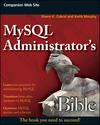
On the front cover of MySQL Administrator’s Bible is a sentence that
reads:
“The book you need to succeed!”
I must say, I do agree. Authored by two very experienced DBAs,
Sheeri Cabral and
Keith Murphy, they’ve combined their talents to
cover what you really need to know to succeed. This book is very
versatile. If you’re new to MySQL, or experienced in another
database and have to start administrating MySQL, you need this
book. I can honestly say, even if you have years of MySQL
experience, you will learn something new. I did. Divided into
four parts, MySQL Administrator’s Bible …
Jun
16
2009
On the front cover of MySQL Administrator’s Bible is a sentence that
reads:
“The book you need to succeed!”
I must say, I do agree. Authored by two very experienced DBAs,
Sheeri Cabral and
Keith Murphy, they’ve combined their talents to
cover what you really need to know to succeed. This book is very
versatile. If you’re new to MySQL, or experienced in another
database and have to start administrating MySQL, you need this
book. I can honestly say, even if you have years of MySQL
experience, you will learn something new. I did. Divided into
four parts, MySQL Administrator’s Bible …