Showing entries 16433 to 16442 of 44965
« 10 Newer Entries | 10 Older Entries »
Designing a database interface for programmers

How do you connect to and converse with your database of choice (MySQL, in my case)? Chances are it’s largely formed by the programming language you choose. I’ve worked with a variety of programming languages. Anytime I begin learning a new one, I am reminded again that there’s more than one way to skin a cat.

Over the last few years, I’ve mostly programmed in Perl and shell. The shell interface to MySQL is simple: the mysql command-line tool. There is not much to think about. In Perl, however, the standard is to use DBI. I have grown accustomed to DBI over the years, but that doesn’t mean I like it. I think it’s one of the worst database APIs I’ve seen. The abstractions it uses (there are only two object abstractions: connections and “statement handles”) are awkward to the extreme.

It does get worse, though. PHP historically used libmysql’s C library for connecting to MySQL, and similarly used native …

[Read more]
Presenting at tomorrow’s NoVA MySQL Meetup (DC Area)

At tomorrow’s NoVA MySQL October Meetup, I will give a talk: “Fractal Tree Indexes – Theoretical Overview and Customer Use Cases.” The meetup is 7 pm Tuesday, October 23, 2012, and will be held at AOL Campus HQ in Dulles VA.

Most databases employ B-trees to achieve a good tradeoff between the ability to update data quickly and to search it quickly. It turns out that B-trees are far from the optimum in this tradeoff space. This led to the development at MIT, Rutgers and Stony Brook of Fractal Tree® indexes. Fractal Tree indexes improve MySQL® scalability and query performance by allowing greater insertion rates, supporting rich indexing and offering efficient compression. They can also eliminate operational headaches such as …

[Read more]
Slides From Northeast PHP Talks

I was asked about slides for my talks at Northeast PHP, so I figured I would post them here so folks could benefit. I gave three MySQL talks. In the list below, the talk name links to the description on the conference website, and you can get the slides by clicking the “PDF slides” links.
Are You Getting the Best Out of Your MySQL IndexesPDF slides
Getting Rid of Scheduled Tasks Using MySQL EventsPDF slides

[Read more]
MySQL Cluster 7.3 - Join This Week's Webinar to Learn What's New

The first Development Milestone and Early Access releases of MySQL Cluster 7.3 were announced just several weeks ago. To provide more detail and demonstrate the new features, Andrew Morgan and I will be hosting a live webinar this coming Thursday 25th October at 0900 Pacific Time / 16.00 UTC

Even if you can't make the live webinar, it is still worth registering for the event as you will receive a notification when the replay will be available, to view on-demand at your convenience

In the webinar, we will discuss the enhancements being previewed as part of MySQL Cluster …

[Read more]
Jumpstart your MySQL Cluster Knowledge

Join companies in the web, gaming, telecoms and mobile areas by learning about MySQL Cluster's distributed, shared-nothing, real-time design.

The 3 days, MySQL Cluster course teaches you how to configure and manage the cluster nodes to ensure high availability. Learn how to install different nodes and understand cluster internals. Here is a sample of some events on the schedule for this course:

 Location

 Date

 Delivery Language

 Wien, Austria

 4 February, 2013

German 

 Prague, Czech Republic

 10 December, 2012 …

[Read more]
Using lookup tables

My students wanted an example of how to use a lookup table in the database. I thought it would be a great idea to create a simple example like this one.

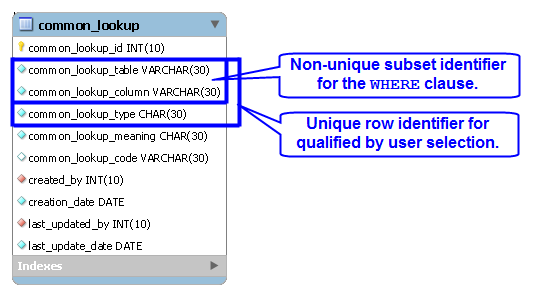
A lookup table is a generalization that holds lists of values that support end-user selections. The following example uses a combination of the common_lookup_table and common_lookup_column columns to identify sets of value for drop down lists. The end-user selects a value from the list to identify a unique row, and returns a common_lookup_id surrogate key value.

The sample code uses the table defined in the previous illustration. It uses a simple HTML drop down list, a PHP library.inc file, and an HTML display form. Below is the drop down selection set for a table and column value.

[Read more]
OblakSoft Cloud Storage Engine Newsletter, October 2012

MySQL on Amazon S3: ClouSE version 1.0b.1.4 is released

OblakSoft is pleased to announce the release of ClouSE version 1.0b.1.4.  In this release we fixed some of the known ClouSE Beta limitations that required workarounds in some configurations.

In particular, now the popular BuddyPress WordPress plugin can store its tables in ClouSE without a patch that worked around the missing features.  If you’re using the patched version of BuddyPress 1.6.1 provided by us, you can now upgrade ClouSE and use the original BuddyPress sources.  Thank you for your patience and commitment!

Here is the summary of changes:

  • Support for latest MySQL 5.5

Now ClouSE supports MySQL thru 5.5.28.  To keep the distribution small, we don’t build binaries for MySQL prior to 5.5.17 …

[Read more]
Designing a database interface for programmers

How do you connect to and converse with your database of choice (MySQL, in my case)? Chances are it’s largely formed by the programming language you choose. I’ve worked with a variety of programming languages. Anytime I begin learning a new one, I am reminded again that there’s more than one way to skin a cat. Over the last few years, I’ve mostly programmed in Perl and shell. The shell interface to MySQL is simple: the mysql command-line tool.

A Couple of Substring Functions: substr_count() and substr_by_delim()

A problem that sometimes when writing queries or stored routines is the need to use strings to do basic manipulation of the data. While from a performance perspective it is generally faster to do these manipulations inside the application, for various reasons it may be desirably to keep things inside MySQL.

This post lists two stored functions that can be used for simple manipulation of strings.

substr_count()

This is a port of the PHP function of the same name. It counts the number of times a given substring is encountered in a text. The signature is:

substr_count(
   in_haystack mediumtext,
   in_needle varchar(255),
   in_offset int unsigned,
   in_length int unsigned
) RETURNS int unsigned

The function as it stands here, has the following limitations and behaviours:

  • As the MySQL convention is to use 1 as …
[Read more]
MySQL AutoTuner

After reading a blog post about MySQL Tuning scripts I thought about the possibility of a fully Automatic MySQL Tuner.

This is how it would work:
A daemon which would connect to your database server and then fetch status variables, just like mysqltuner and such. Then the daemon could decide that a parameter would need to be adjusted and then run "SET GLOBAL …" and write a /etc/mysql/autotuner.cf file which should be included in your my.cnf.

It should have a min/max setting for each option and some thresholds.

Why?

  • Not everyone is a DBA
  • It's could better than the default settings is most cases. Luckily many defaults are updated in 5.6.
  • You're not using my-huge.cf, are you?
  • It could help when there are changing workloads
  • It might be sufficient for …
[Read more]
Showing entries 16433 to 16442 of 44965
« 10 Newer Entries | 10 Older Entries »