Everyone realizes MySQL released 5.0 right? In other news two
weekends ago some woman hunted me down at a party and told me
that she just must have Geometry support in other engines then
MyISAM. The story was a bit complicated, but somehow she hunted
me down through someone who knew me, who just also happen to know
that I would attend a particular party. She swung an invite just
so that she could ask that we make the feature happen. When
5.0.16 comes out Archive, NDB (aka cluster), Innodb, and BDB all
now support geometry types.
At this point I would like to recommend people to go through
MySQL support instead of hunting me down at parties ok?
On a different note 5.1 has started to come into shape. If you
have been watching bk commits you would notice that Federated now
has transactions on tables. I hacked it up one night and have now
left it to poor Eric to spend his next month documenting it and
adding the needed …
The last week big news hung in air: the long awaited MySQL 5 came as a GA (Generally Available) version out. After a week beta phase (thanks to all testers) we now can announce the first "final" version of XAMPP containing the new MySQL to the public: XAMPP for Linux 1.5!
Also new in this version of XAMPP: upgraded version of Apache (2.0.55), PHP (4.4.1), phpMyAdmin (2.6.4-pl3) and OpenSSL (0.9.8a).
Appropriate versions for Windows and Mac OS X follow in the next days.
Now as MySQL 5.0 is finally released as GA, or stable I guess
many of your are asking yourself if it is the time to
upgrade.
Let me express my opinion on this matter.
First I guess most of you running live application would follow
"do not fix what is not broken" rule, and I think this is
right.
I know number of installations still running MySQL 3.23 quite
successfully and even larger number of people happy with
4.0
I would not stay with 3.23 until now as it is barely supported -
it might work well for you still but if you run into some
issue
it will unlikely be fixed in 3.23 and you might be forced to
upgrade to 4.0 while you're not ready. You will also likely find
a lot of
gotchas in this release, which are often already erased from
developers memory, also most mailing/forum members are running
higher versions.
With MySQL 5.0 being released I expect …
Now as MySQL 5.0 is finally released as GA, or stable I guess
many of your are asking yourself if it is the time to
upgrade.
Let me express my opinion on this matter.
First I guess most of you running live application would follow
"do not fix what is not broken" rule, and I think this is
right.
I know number of installations still running MySQL 3.23 quite
successfully and even larger number of people happy with
4.0
I would not stay with 3.23 until now as it is barely supported -
it might work well for you still but if you run into some
issue
it will unlikely be fixed in 3.23 and you might be forced to
upgrade to 4.0 while you're not ready. You will also likely find
a lot of
gotchas in this release, which are often already erased from
developers memory, also most mailing/forum members are running
higher versions.
With MySQL 5.0 being released I expect …
Someone at work today pointed out a podcast from Tom Kyte (a fountain of Oracle knowledge who‘s really hooked into his user community) of Oracle that covers Oracle 10g XE (their “free” product).
Both Tom Kyte and Oracle use Feedburner to deliver their podcasts and other RSS feeds (a great service btw, I use their application to deliver my blog‘s RSS feed as well, plus they‘re in Chicago, so I‘ve visited with their folks a few times).
What I find ironic is that Feedburner uses MySQL and Connector/J to power their service ;)
Someone at work today pointed out a podcast from Tom Kyte (a fountain of Oracle knowledge who's really hooked into his user community) of Oracle that covers Oracle 10g XE (their "free" product).
Both Tom Kyte and Oracle use Feedburner to deliver their podcasts and other RSS feeds (a great service btw, I use their application to deliver my blog's RSS feed as well, plus they're in Chicago, so I've visited with their folks a few times).
What I find ironic is that Feedburner uses MySQL and Connector/J to power their service ;)
Someone at work today pointed out a podcast from Tom Kyte (a fountain of Oracle knowledge who‘s really hooked into his user community) of Oracle that covers Oracle 10g XE (their “free” product).
Both Tom Kyte and Oracle use Feedburner to deliver their podcasts and other RSS feeds (a great service btw, I use their application to deliver my blog‘s RSS feed as well, plus they‘re in Chicago, so I‘ve visited with their folks a few times).
What I find ironic is that Feedburner uses MySQL and Connector/J to power their service ;)
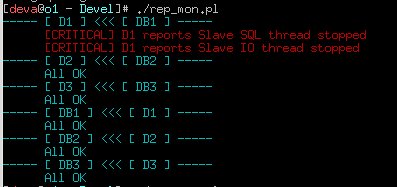
Finally! Last night, I put the finishing touches on the
documentation, and uploaded to SourceForge. Well, finishing
touches for a first alpha, hehe - still, it's a good step! Anyone
with Perl installed should be able to download Mycat-0.1.2.tgz,
untar, edit the config file (mycat.cnf), and run rep_mon.pl to
see the status of replication on their servers.
Mycat-0.1.2 release notes
I will add the "rcall" script next, but I can't decide whether
it's name comes from "Run Command on all" or "Remote Call"...
decisions, decisions... anyhow, rcall relies on ssh key-based
remote execution of commands, and is not specific to any MySQL
installation. It is none the less an indispensable tool for me,
when working with large …
I noticed my previous blog on creating crosstabs in MySQL has generated some
attention. It made me find out that I didn't do my homework as
well as I would've liked.
Whilst writing it, I googled a bit for solutions, and I did
stumble into a PERL solution written by Giuseppe
Maxia. However, I totally missed Giuseppe's excellent article that is referred
to by Beat
Vontobel's blog entry describing
a stored procedure that solves this problem for the general
case.
Thank you guys, I learnt a lot from those!
Reading all that made me rethink the problem. In doing so, I
thought of a little …
Updated: Network World's coverage here.
OK, this was a great move, including this session. (Thanks for the recommendation,
Bryce.)
The premise is simple: startups spend a lot of time pitching to
VCs, and the VCs theoretically talk to CIOs for a gut check on
the idea. We wanted to remove the "information middleman" and
have the startups pitch CIOs, in real time.
The result?
Peter Yared (CEO of ActiveGrid) talked about their next generation
application server (credible, given that the team came from BEA,
IBM, Sun).
- He got a little negative feedback …