If you want to know more about MySQL and MariaDB plugins read below. Our (Andrew Hutchings and mine) book MySQL 5.1 Plugins Development was just published by Packt. As far as I know it’s the first and the only book completely dedicated to MySQL Plugin API. It covers all existing in 5.1 plugin types, from Daemon to Storage Engines, and does not shun from explaining less known or poorly understood features of the plugin API. It describes newer plugin API extensions too – such as authentication plugins and recent CREATE TABLE extension. Also …
[Read more]
Sep
15
2010

Sep
15
2010
Last week’s webinar on getting started with MySQL Cluster and the scaling it out is now available to download from http://www.mysql.com/news-and-events/on-demand-webinars/display-od-566.html
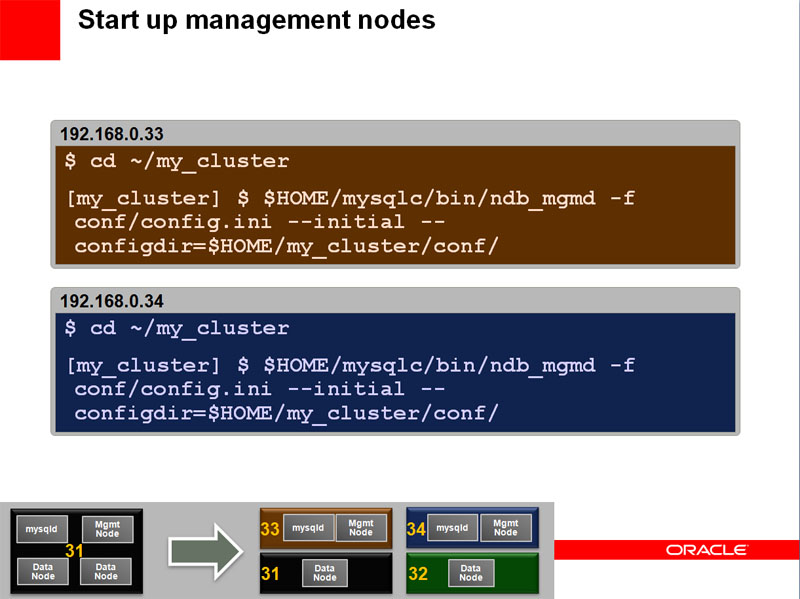
MySQL Cluster - getting started webinar
It was great that so many people were able to attend live but if you missed it then the replay is a good way to catch up.
This session demonstrates how to start an evaluation of the MySQL Cluster database in 5 easy steps, and then how to expand your deployment for web & telecoms-scale services. The getting started section covers:
- Getting the software
- Installing it
- Configuring it
- Running it
- Testing …
Sep
15
2010
It is great to be able to build small utilities on top of an excellent RDBMS. Thank you MySQL.
This is a small but complex utility to perform online schema change for MySQL. We call it OSC and the source is here.
Some ALTER TABLE statements take too long form the perspective of some MySQL users. The fast index create feature for the InnoDB plugin in MySQL 5.1 makes this less of an issue but this can still take minutes to hours for a large table and for some MySQL deployments that is too long.
A workaround is to perform the change on a slave first and then promote the slave to be the new master. But this requires a slave …
[Read more]
Sep
15
2010
Available immediately Flexviews 1.6.0-RC2.
This release is a bugfix release. This is the second
Flexviews release candidate. If no major bugs are
discovered the next release will be the GA release.
Flexviews is a stored procedure managed materialized view system
for MySQL 5.1 or greater.
What is fixed in Flexviews 1.6.0-RC2?
- Numerous performance fixes.
- Flexviews uses fewer temporary tables and subqueries
- A full table scan of the view is no longer required (only changed GB keys are scanned)
- Dead code has been removed
- Bug fixes
- Removing tables and adding them to a view again could result in the WHERE clause being generated in the wrong order
- Fix a problem with applying deltas to views which use PERCENTILE …
Sep
14
2010
A new start-up claims it can scale MySQL for the cloud, making it easier for applications to grow at a rapid pace.
Sep
14
2010
Have you ever been in the situation where you were searching for a certain example without success? Ever wanted to ask for inspiration but you havn't found the right audience? Ask the sqlexamples.org community, your friendly resource for database developers and administrators right around the corner !
Our aim is it to provide free examples and open ideas for all practical purposes. When there is something missing, simply add it to our wishlist and we will try to fulfill your wish as soon as possible. Create an account and start to share your desires! We're looking forward to fulfill your wish as well!
Sep
14
2010
Back in 2008 Stonebraker & DeWitt published a paper and associated blog post titled “MapReduce: A major step backwards”. Their key points being Map Reduce is:
-
A giant step backward in the programming paradigm for
large-scale data intensive applications
-
A sub-optimal implementation, in that it uses brute force
instead of indexing
-
Not novel at all — it represents a specific implementation
of well known techniques developed nearly 25 years
ago
-
Missing most of the features that are routinely included in
current DBMS
- Incompatible with all of the tools DBMS users have come to depend …
Sep
14
2010
English translation of first and only chapter of last part 4
"Techniques, used for debugging of Production applications" just
published.
Chapter 11. Techniques, used for debugging of Production
applications.
Unfortunately is not always possible to find error while testing.
Often they only happen when high load.
How do you know about such problems?
One of most important sources of information about problems is
error
log file. There you can find information such as server
crashes,
connection errors (if option log-warnings=2 turned on), about
options
which were specified in the configuration file, but had not
turned on
because error and some others. There is a rule for working with
error
log file: if something unexpected happens check error log first.
Error
log file also contains information …
Sep
14
2010
English translation of first and only chapter of last part 4
"Techniques, used for debugging of Production applications" just
published.
Chapter 11. Techniques, used for debugging of Production
applications.
Unfortunately is not always possible to find error while testing.
Often they only happen when high load.
How do you know about such problems?
One of most important sources of information about problems is
error
log file. There you can find information such as server
crashes,
connection errors (if option log-warnings=2 turned on), about
options
which were specified in the configuration file, but had not
turned on
because error and some others. There is a rule for working with
error
log file: if something unexpected happens check error log first.
Error
log file also contains information …
Sep
14
2010
Hi,
If you are coming to this year’s Oracle OpenWorld 2010, the largest gathering of database enthusiasts, please do visit us at booth #3729. We will be more than happy to answer your queries, demo new features and interact with you on our product road-map.
We are also giving away 50 Discover passes for the event. Contact us at oow2010@webyog.com to claim your pass now!
Cheers,
Team Webyog