Now it's time to get serious about replicating to MariaDB from
Oracle, and we are real close now, right? What I needed was a
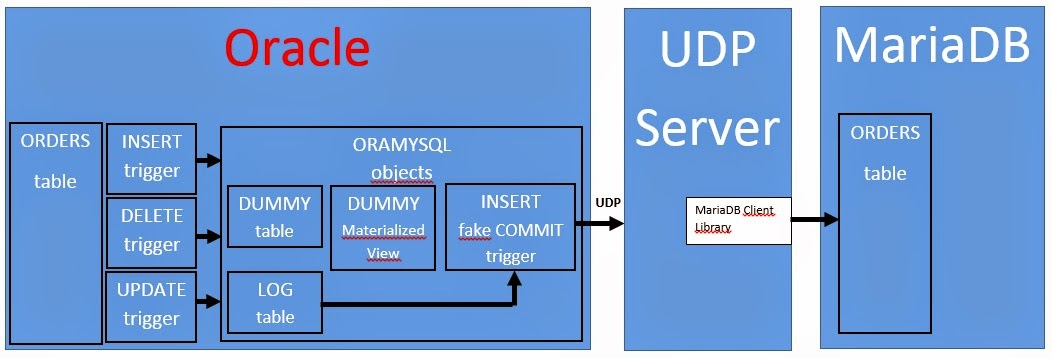
means of keeping track of what happens in a transaction, such as
a LOG table of some kind, and then an idea of applying this log
to MariaDB when there is a COMMIT in Oracle. And thing is, these
two don't have to be related. So I can have a table which I write
to and also have a Materialized View that is refreshed on COMMIT
on, and I need a log table or something. And when the
Materialized View is refreshed, as there is a COMMIT, then the
log can be applied. From a schematic point-of-view, it looks
something like this:
This looks more complex than it is, actually,
all that is needed is some smart PL/SQL and this will work. I
have not done much of any kind of testing, except checking that
the basics …
In time for Oracle OpenWorld 2014, we released Connector/Python 2.0. We also released a labs release Connector/Python 2.1 and we have a new feature: a C Extension which uses Connector/C.
This C Extension is an optional, an alternative to the pure Python MySQL Client protocol implementation. One of the reasons to implement it was to improve performance in some situations, for example, when huge result sets are returned. Pure Python is still default, if C Extension is not available.
The following post will get your through downloading and installing the MySQL Connector/Python 2.1.0 labs release.
Requirements
- Windows users out of luck; the labs release only compiles on Linux, OSX …
In time for Oracle OpenWorld 2014, we released Connector/Python 2.0. We also released a labs release Connector/Python 2.1 and we have a new feature: a C Extension which uses Connector/C.
This C Extension is an optional, an alternative to the pure Python MySQL Client protocol implementation. One of the reasons to implement it was to improve performance in some situations, for example, when huge result sets are returned. Pure Python is still default, if C Extension is not available.
The following post will get your through downloading and installing the MySQL Connector/Python 2.1.0 labs release.
Requirements
- Windows users out of luck; the labs release only compiles on Linux, OSX and other …
Today SkySQL is changing its name to MariaDB Corporation.
This is something that I had both anticipated and I think it's a
great step for MariaDB.
I wanted here to to share my thoughts on how this change affects
the MariaDB community.
The short version: As the MariaDB Corporation is the main driving
force behind the development of the MariaDB server and the
biggest support provider for it, it makes sense to give it a name
that clearly communicates this fact. The name change
doesn't of course stop the company to continue it's excellent
support for MySQL.
For MariaDB users and customers, the name change should not
affect them in any way, except that it will make it easier for
them to find more information about MariaDB as there is fewer
names involved.
For the …
MySQL Fabric Support
MySQL Fabric servers can now be added to the Workbench home screen. When clicked, these connections will dynamically query the Fabric server and individual connections for all the managed MySQL servers will be created. You can then connect to each instance as usual.

Metadata Lock Browser
MySQL uses metadata locking to manage access to objects (tables, triggers, and so forth). Sometimes that can be puzzling, as your query may block waiting on an object being manipulated by another connection from maybe another user. The Client Connections list was updated to take advantage of the metadata lock information provided in the performance_schema starting in MySQL 5.7.3, to show …
[Read more]We have received a lot of requests from our user community regarding the ability to truncate UNDO tablespaces (‘truncate’ here means that the size of the tablespace is reset back to what it was when it was first created). We are happy to say that we’ve now been able to implement this anticipated feature.
Introduction
The InnoDB UNDO tablespace(s) host rollback segments that hold rollback information related to database changes. This information is used to rollback a transaction and to retrieve the previous version of a record that has been updated or deleted for multi-version concurrency control (MVCC). Once a transaction is committed, InnoDB will discard the related UNDO log records. UNDO log records for updates or deletes will be kept around as long as there exists an open transaction that may access older versions of the records. When all such open transactions are committed then the associated UNDO log records can …
[Read more]The multi master plugin for MySQL is here. MySQL Group Replication provides virtually synchronous updates on any node in a group of MySQL servers, with conflict handling and automatic group membership management and failure detection.
For a better understanding on how things work, we go under the hood in this post and will analyse the transaction life cycle on multi master and which components does it interact with. But before that we need to understand first what a group is.
Group Communication Toolkit
The multi master plugin is powered by a group communication toolkit. This is what decides which servers belong to the group, performs failure detection and orders server messages. Being the ordered messaging the magic thing that allows the data to be consistent across all nodes. You can check the details of the group communication toolkit at …
[Read more]More MySQL releases than ever before. Check out the following that we just released:
– MySQL Connector Java 5.1.33 GA
– MySQL Fabric & MySQL Utilities 1.5.2 GA
– MySQL Connector Python 2.0.1 GA
– MySQL Fabric and Utilities 1.6.0 Alpha
– MySQL Connector C (Labs)
– MySQL Connector Python (Labs)
– MySQL Group Replication (Labs)
– MySQL HTTP Plugin (Labs)
Download from http://dev.mysql.com/downloads/ and http://dev.mysql.com/downloads/
Percona is pleased to announce the availability of Percona Toolkit 2.2.11. Released on Sept. 25, Percona Toolkit is a collection of advanced command-line tools to perform a variety of MySQL server and system tasks that are too difficult or complex for DBAs to perform manually. Percona Toolkit, like all Percona software, is free and open source.

This release contains bug fixes for pt-query-digest, pt-mysql-summary, pt-stalk, as well as other tools and is the current GA (Generally Available) stable release in the 2.2 series. Downloads are available here and from the …
[Read more]The multi master plugin for MySQL is here “MySQL Group Replication“. It is a virtual synchronous solution for MySQL with conflict detection. It also supports automatic group membership management, failure detection and automatic distributed recovery.
With the introduction of this new feature there was a need to perform some good amount of testing as it involves complex functionalities like :
- Servers execute local transactions and broadcasts the update to the group.
- All servers in the group, even the sender, receive same transaction in the same order and check for conflicts.
- All servers, independently, decide to commit the transaction – no conflicts.
- A new node can join an existing group, so in this case we need distributed recovery to bring it at par with the other servers.
So a great deal of effort has been spent on testing these …
[Read more]