A few days in the job for MySQL and still, even though I can't
say I have mastered the tasks at hand (too much to get used to!)
I tasted the feeling of working with perople living in different
time zones.
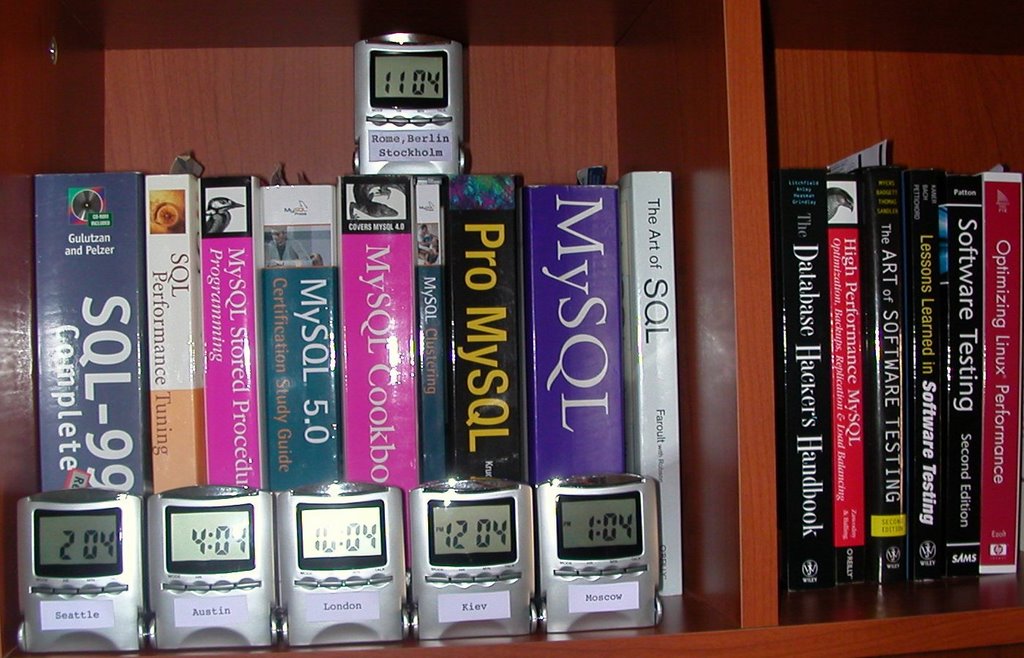
To make this feeling more real, I went to a Chinese shop a few
blocks down my street and I bought six cheap clocks. I know that
I could use the net but the tangible clocks give me a sense of
being in a "real office"!
Sep
28
2006
Sep
28
2006
A few days in the job for MySQL and still, even though I can't
say I have mastered the tasks at hand (too much to get used to!)
I tasted the feeling of working with perople living in different
time zones.
To make this feeling more real, I went to a Chinese shop a few
blocks down my street and I bought six cheap clocks. I know that
I could use the net but the tangible clocks give me a sense of
being in a "real office"!

Sep
28
2006
Lorenzo has startet working on better charset support in MDB2. He has added basic support for setting charsets and collations inside field definitions in CVS already. However, there are still plenty of open questions to look at. I have only limited experience with charsets in MySQL. Lorenzo has some experience with Firebird and PostgreSQL. But this is no where near sufficient to come up with a solution that would work reasonably well across all supported drivers. Check out his charset RFC on his blog. Comments are very much appreciated, even if they just highlight problems without giving a solution just yet.
Sep
28
2006
Donald Feinberg, the chief database analyst at Gartner, provided a very thorough analysis of the impact of open source technology in the database market at the Gartner Open Source Summit in Phoenix this week. Feinberg has been in the database market since there was a database market, and he has the insights (and the scars) to prove it. Unlike a lot of analysts in the industry, Feinberg doesn't just stick to what's politically correct; he says what needs to be said, whether it's about open source ("Don't go into production without comercial support"), Unix ("It's dead; I just don't know when the funeral is") or proliferation of technology ("No one plans on having 10,000 Access databases, but if you don't have a policy you wake up one day and that's what you have.")
Overall, Gartner is predicting that the …
[Read more]
Sep
28
2006
We’ve been getting lots of questions about how MySQL 5.1 optimises queries on partitioned tables. Recently, we added some new information about this to our Internals Manual provided by one of our developers, Sergey Petrunia. (I hope that my edits and formatting haven’t messed up anything — if there are any problems with what’s been published in the Internals Manual, then the fault’s probably mine and not his.)
The new section can be accessed here, and includes coverage of the following topics:
- An overview of how MySQL performs partition pruning
- What partitioning and subpartitioning intervals are, and why they’re important
- Converting
WHEREandONclauses into intervals - Partition selection
- Where to find partition pruning and selection code in …
Sep
28
2006
Yup. It's time to start thinking about another MySQL Conference. The Call for Participation is now up and I've been told that we will definitely have a Windows/.NET track again this year. The Conference will be held at the same location as last year from April 23 to April 26, 2007. Our conferences have grown every year and I expect this year to be no different, so get those proposals in before the November 7 deadline and hopefully I'll see you there!
Sep
27
2006
Want to squeeze a bit more performance out of your MySQL install? Make sure you're not using swap!
Of course you were probably smart enough to make sure MySQL wasn't using all the systems memory to begin with so in theory you shouldn't be swapping. Good idea but the Linux VM isn't that clever.
It can still make poor decisions and decide to swap portions of MySQL out to disk which can end up hindering performance when it needs to page them back into memory. In replicated installs this can yield to periodic situations where certain MySQL slaves fall far behind and take 30 minutes or more to catch up with the master.
If you're not sure your MySQL install isn't using swap you can
use vmstat to see realtime stats but I'd recommend
using Munin or Ganglia as well.
What you …
[Read more]
Sep
27
2006
A while back I did Cache Performance Comparison for LAMP Stack.
Looking at this data you can see memcached is about 5 times as slow as APC, and this is with tests done on localhost - with network difference is going to be larger, even with fastest network. Such latency can add up especially if you're, being lazy "P" Developer, request objects from cache one by one rather than fetching all items you need for the page at once (not to mention this is not always possible).
So I thought if there is any way to use both of them at once
benefiting from strong sides of each of them.
APC Cache (Eaccelerator and other similar caches) is Fast but it is not distributed so you're wasting cache and reducing possible hit rate by caching things locally if you have many web servers. MemcacheD is relatively slow but distributed and …
[Read more]
Sep
27
2006
When I was leaving MySQL I wrote I will be doing some Web projects on my own, besides doing MySQL Consulting. I think some people thought I am just using that as an excuse and really I will only do consulting. So I'm pretty happy to announce my first project.
NNSEEK Is NewsGroup search engine, as well as NewsGroup->Blog converter, allowing people to view NewsGroups as blog, meaning threads starts are showed as posts and replies are shown as comments.
It is quite early version so at this point - it has number of little problems, rough edges, it is also not overly optimized in terms of performance yet, but it is …
[Read more]
Sep
27
2006
This Saturday, the 30th, at 4pm, I will be giving a session on MySQL Performance Tuning guidelines at the Ohio LinuxFest, at the Greater Columbus Convention Center. It is directly followed by the PostgreSQL session given by Christopher Browne, so if you're into databases and live in the Ohio area, you should have a bunch of geeks to bond with and share war stories. I'll actually be at the conference for most of the day. Come find me; I'll by wearing my MySQL shirt so I should be easy to find — I'll be challenging PostgreSQL guys to arm-wrestling bouts. Hmmm, forget that. If memory serves me correctly, at Marten's cookout this past April I fared pretty darn poorly in that arena. Best stick to lively debate.
As an aside, I've always …
[Read more]