Last Friday the Dutch TV program Zembla aired part two of the "verzuimpolitie" series.
The first part was mainly about how employers
could access medical information about employees. There is a news
article about the second part here (with google translate).
The second part is about the security of the
IT system which is used to record medical information about
employees. They give this information to the company to which the
company they're working for is outsourcing everything related to
workplace absenteeism.
After the first part of the series some viewer reported that the
website contained SQL injections. The creators of the program
verified this and tried to report it to VCD (The company which
offers the software as a service). Then VCD called to police to
remove them from the VCD office.
Then Zembla contacted the Radboud University and asked them to assist
with this issue. The University verified the SQL Injection and
confirmed that this was a serious security flaw. Then a VCD
executive told Zembla that there wasn't a SQL Injection, someone
just stole the passwords. This is strange because VCD reported to
the University that they recorded a SQL Injection attack by the
University.
The users of the VCD Humannet software were not informed. And
when some of the companies using this SaaS service became aware of the security incident
it took a lot of effort before the service was temporarily
shutdown to prevent further harm.
This whole story reminded me of the situation around Comodo and
DigiNotar. Comodo was hacked, stopped the issuing process,
reported the issue and fixed it. Then DigiNotar was hacked, did
not stop the issuing process. It also didn't report the issue.
Then they became bankrupt.
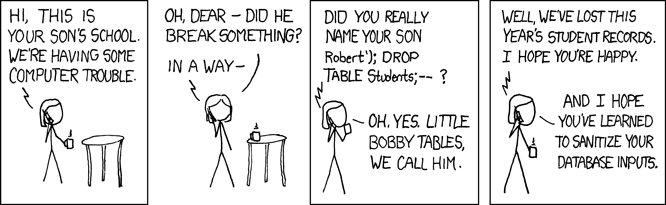
The lessons learned for SQL Injections for DBA's and
Application Developers:
1. Input validation. This is obvious.
2. Use prepared statements if possible.
3. Prepare for a security incident: make it easy to disable
applications or parts of applications.
If all client companies are in the same database then it's very
hard to shutdown the application for just one company. Using one
database instance per client company might be a solution.
4. Use isolation
If there are 10 client companies and they all use different
databases as separation, then you should also use 10
application users with the correct permissions. Then a SQL
injection for one customer won't affect other customers.
5. Use a database firewall.
This is not very common yet. You could use GreenSQL or
McAfee (partly opensource). There are more
solutions available, but these are at least partly
opensource.
6. Use two factor authentication if dealing with sensitive
data.
You don't have to buy expensive tokens. There are enough free or
almost free solutions available. Yubikey is a
possible solution.
7. Do not store passwords, store hashes.
8. Use encryption an function like AES_ENCRYPT() to encrypt sensitive data.
This could guard your data from 'curious' DBA's and other
administrative users.
Do not use a hardcoded password for this! Make sure that
the AES_ENCRYPT doesn't end up in your binlogs, use a variable!
And only use TLS secured connections. It might be better to
encrypt the data in the application instead of in the database.
It could even be possible to use client side encryption to
encrypt the data in the browser.
9. Remove old authentication methods, login screens, etc.
The lessons learned for SQL Injections for
management:
1. Security scans are mandatory. Companies like Madison Gurkha and Fox IT can offer
this.
2. Don't only inclue your own services in security scans, but
also the external services you use.
3. Make sure that there is a security breach notification
requirement in the contracts for security sensitive
services.
4. Make it easy to report security incidents.
5. Do shutdown the service if needed for security.
6. Do inform your customers about the security incident.
Apr
22
2012