This release has now been replaced with 7.0.9b
The source version for MySQL Cluster 7.0.9a has now been made available at ftp://ftp.mysql.com/pub/mysql/download/cluster_telco/mysql-5.1.39-ndb-7.0.9a/
This replaces MySQL Cluster 7.0.9.
You can either wait for the binaries to be released or if you’re in a rush then you can find instructions on building the binaries for yourself in the earlier article: “MySQL Cluster 7.0.7 source released“.
A description of all of the changes (fixes) that have gone into MySQL Cluster 7.0.9a (compared to 7.0.8a) can be found in the MySQL Cluster …
[Read more]This release has now been replaced with 6.3.28b.
The source version for MySQL Cluster 6.3.28a has now been made available at ftp://ftp.mysql.com/pub/mysql/download/cluster_telco/mysql-5.1.39-ndb-6.3.28a/
This replaces MySQL Cluster 7.3.28 which has been withdrawn.
You can either wait for the binaries to be released or if you’re in a rush then you can find instructions on building the binaries for yourself in the earlier article: “MySQL Cluster 7.0.7 source released“.
A description of all of the changes (fixes) that have gone into MySQL Cluster 6.3.28a (compared to 6.3.27) can be found in the MySQL Cluster …
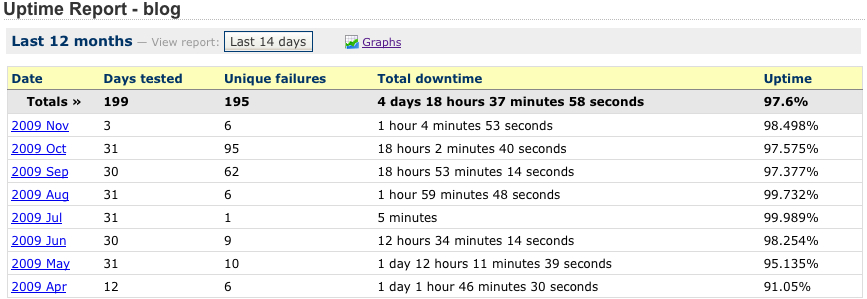
[Read more]I don’t care what their marketing stats say, I have my own indepedent verification. I’ve been using Wormly for quite a while monitoring some of my demo sites, and other services that are part of Bayon and part of Dynamo. Since I was already paying for it, I figured I’d turn it loose on this blog (nicholasgoodman.com) and see what the uptime was like.
I always thought Dreamhost was a little skiddish, and my email box finds approximately one email per day with a failure, but i figured they were small, single request failures. Nope. The independent measuring of the uptime of this blog is a CRUDDY, CRAPPY, 97.6%.
That’s pathetic! My blog is nothing special, an out of the box
WordPress installation backed by their MySQL. I haven’t done any
of my own installations, customizations (excepting a theme) and
yet …
Then please contact us: i n f o (at) o u r d e l t a (dot) o r g
What are the requirements? Having a server with HTTP access and no hassles with low traffic limits. At this stage you’ll need about 5GB disk space, and you’ll use rsync to sync from the master servers (we’ll provide you with a script to help with that). Thanks!
With the new releases the traffic is up (not surprising) and while our existing mirrors appear to be doing ok so far, it’ll be good to have more available before we run into capacity or speed problems. We also haven’t yet split for geographic location, that too becomes a possibility with more mirrors.
We've launched: open source alpha available now at
infinidb.org
See www.infinidb.org for details.
The intention will be to post information specific to
InifiniDB performance, scalability, or features on that
site. Topics here may be more general in nature, i.e.
comparisons of column versus row for different use cases that may
apply to any column architecture dbms.
So, MySQL 6.0 was ditched, and a few weeks ago 5.4 was also – its features to be added in other (earlier) versions (I’m told 5.2 but not sure). I reckon that’s good news, regardless of the version number. There was also an announcement about a change in the release mechanism at Sun/MySQL.
Now for practicals. If I look on Launchpad, the 5.1 branch is the only active one (next to 5.0 fixes, of course). 5.4 was last updated 15 weeks ago. There is no 5.2 on there that I can find. Wasn’t looking for it really, just happened to notice its absence while I was trying to find 5.5. And the reason for that was that Miguel closed a bug I was following, noting it was no longer reproducible in 5.5. He pastes some code that reports mysql as 5.5, so it’s not a typo.
So, in addition to the above list of …
[Read more]We have servers that run with innodb_log_file_size=256M and some of these servers do a lot of disk writes per second. I want to know whether performance will improve with a larger value for innodb_log_file_size and setup two test servers that used 256M and 512M for it and then ran a mirror of the production workload on them.
The results are interesting. The benefit varies from significant to not much depending on how you measure. With this change the write rate was reduced:
- 4.5% as measured by iostat w/s
- 13% as measured by iostat wsec/s
- 18% as measured by Innodb pages written.
I then added the my.cnf variable innodb_flush_neighbors_on_checkpoint to MySQL. There are several conditions under which InnoDB writes dirty pages. One reason for pages to be flushed …
[Read more]I was working on a server today that was not hooked up to our usual monitoring systems for one reason or another and I needed to generate a database tuning report. Typically I use Matthew Montgomery’s ‘tuning-primer.sh’ script for this since it’s command line based, simple to use, and generates a number of useful items for tuning recommendations. It’s a great starting point before delving into the deeper aspects of MySQL and the OS.
I ran into an issue with it on this server that was running the
MySQL 5.0.77-percona-highperf-b13-log x86_64 build. The error
was:
./tuning-primer.sh.1: line 517: 5.000000: syntax error in
  expression (error token is ".000000")
There were three options to fix this issue
- Dive into the code and modify it cowboy style
- Use our typical monitoring against the client’s wishes
- Contact the developer to get a fix
I hopped on …
[Read more]